On 21 October 2025, the Mexican Senate held the second session of its Working Seminars for the International Year of Glacier Preservation, coordinated by APECS-Mexico in collaboration with the Senate’s Commission on Water Resources and Hydraulic Infrastructure.
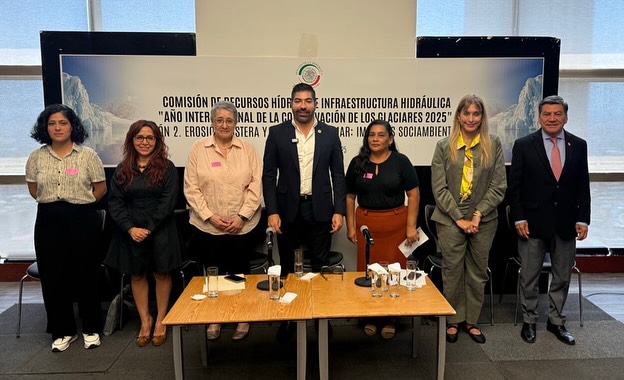 Picture by Senado de la República de México
The session focused on three main topics:
• Consequences of Antarctic deglaciation for Mexican territory
• Case study of the community of El Bosque, Tabasco, the first population in Mexico to experience climate-induced displacement due to sea-level rise and coastal erosion
• Proposals for legal protocols to prevent climate-related displacement and address the needs of affected communities
Panelists
• Guadalupe Cobos Pacheco, community representative and activist from El Bosque
• Lilia Gama Campillo, PhD in Philosophy and MSc in Ecology and Biotic Resources, researcher at the Universidad Juárez Autónoma de Tabasco
• Rosalía Ibarra Sarlat, PhD in Environmental Law, researcher at the Institute for Legal Research of the National Autonomous University of Mexico
• Tania Ximena Ruiz Santos, National Representative of APECS-Mexico
• Maki Esther Ortiz Domínguez, President of the Senate Commission on Environment, Natural Resources, and Climate Change
• Armando Ayala Robles, President of the Commission on Water Resources and Hydraulic Infrastructure
• Óscar Cantón Zetina, President of the Commission on Constitutional Affairs
The objective of this session was to highlight one of the country’s most pressing climate challenges in the public and political arena: the displacement of coastal communities due to climate change and coastal erosion.
APECS facilitated the participation of three key contributors whose work integrates local knowledge, scientific research, and legal analysis. The discussion centered on the case of El Bosque, its documented impacts, and the lessons it offers for future adaptation policies.
The Case of El Bosque
El Bosque was a coastal community in the municipality of Centla, Tabasco, located in a deltaic zone highly vulnerable to coastal erosion. Scientific and journalistic sources document that, over the past decade, the shoreline retreated rapidly due to the interaction of local processes—such as mangrove loss, land subsidence, high-energy wave events, and extreme weather systems—and global processes linked to climate change, including sea-level rise driven by continental ice melt and thermal expansion of the oceans. This retreat resulted in the progressive loss of homes, infrastructure, roads, utilities, and public spaces, rendering the original settlement uninhabitable.
Between 2023 and 2024, in response to the loss of territory, the Government of Mexico formally recognized El Bosque as the country’s first case of climate-induced internal displacement and initiated a relocation process to move families to a new settlement inland. International organizations, academic studies, and civil society reports agree that the relocation reduced immediate physical risk but presents significant challenges for sustaining livelihoods—particularly fishing—due to the new site’s distance from the coast. El Bosque is now considered a key precedent for understanding coastal vulnerability and informing future climate adaptation policies in Mexico.
Guadalupe Cobos Pacheco presented a detailed account of the community’s experience. APECS supported her travel from Tabasco to Mexico City to ensure that this perspective—rarely present in legislative forums—could be shared directly with policymakers.
The Need for Scientific Monitoring
Dr. Lilia Gama Campillo, researcher at the Universidad Juárez Autónoma de Tabasco, provided a scientific analysis of the factors driving coastal erosion in Tabasco, particularly in the area formerly occupied by El Bosque.
She presented data from monitoring efforts and previous studies showing significant land loss over short periods of time. She explained how extreme weather events intensify erosion and accelerate infrastructure failure. Dr. Gama highlighted the need to strengthen systematic monitoring, update risk atlases, and promote interdisciplinary assessments integrating geosciences, meteorology, coastal hydrodynamics, and social dimensions. Her presentation positioned the case of El Bosque as a clear example of how global physical processes interact with regional coastal dynamics.
Legal Frameworks for Preventing and Addressing Climate Crises
Dr. Rosalía Ibarra examined the case of El Bosque from a legal perspective, focusing on existing gaps in national frameworks for addressing displacement caused by environmental processes. She explained that coastal erosion and sea-level rise can simultaneously affect multiple rights, including housing, health, food, water, and livelihoods, requiring a human-rights-based approach. She emphasized that Mexico currently lacks a national policy for internal displacement driven by environmental or climatic factors, which complicates prevention, planning, and comprehensive response.
Dr. Ibarra also noted that relocation processes must be structured to ensure adequate living conditions and economic continuity, as well as mechanisms for informed participation by affected communities. She underscored the importance of accessible technical information, consultation processes, and preventive criteria to avoid disorganized or unsafe displacement. She concluded that the case of El Bosque sets an important precedent for climate justice discussions in Mexico and highlights the need to develop specific regulatory frameworks for emerging climate-related mobility.
Sensory Explorations of the Environmental Crisis
The session concluded with the screening of The Stride of Lichen, a film by director and current APECS-Mexico National Representative Tania Ximena. Shot in Antarctica and in the community of El Bosque, with the participation of Guadalupe Cobos, the short film proposes an artistic approach to understanding the connections between Antarctic processes and environmental transformations in Mexico.
The Senate’s Working Seminars for the International Year of Glacier Preservation began on 8 April 2025 with the session “Cryosphere in Mexico: Sovereignty and a Culture of Peace.” Their goal is to raise awareness among legislators and the public about the importance of the cryosphere for Mexico and the world. The seminars will continue through 2026.
This initiative by APECS-Mexico has been supported by the following members:
Tania Ximena Ruiz, Palmira Cuéllar, Carlos Santiago Amézquita, Daniela Cuauhtémoc, Alejandra Madrigal, and Andrea Rodríguez.
This session, as discussed in this article, was funded by APECS International.