0
News

© Ruth Hindshaw, Francoise Amelineau, Inga Beck, Letizia Campioni, Karolina Paquin (left to right)
Welcome to our news pages where you can catch up on all the latest APECS, Polar and Alpine news. This section is broken up into several categories:
- APECS News: where you can find news from and about the wider APECS Network and our many events, activities and resources organized and developed by the APECS leadership, project groups and National Committees
- Polar and Alpine Community News: news from the many partners that APECS is working with, as well as other news from a variety of sources related to research in the Arctic, Antarctic and Alpine regions as well as the wider Cryosphere.
- APECS Member Bulletin Board: space for our APECS members to (1) share news about their upcoming publications, research or outreach projects, blogs and other Polar and Alpine research / education / outreach-related activities they organize; (2) look for other APECS members to collaborate on a research or outreach project idea they have; (3) search for other APECS members who have a special expertise in an area related to Polar and Alpine research where they might need input from or have a question about.
- APECS Newsletter Archive: APECS publishes a monthly newsletter and past newsletters are available in our APECS Newsletter archive. To get our newsletter, become a member of APECS and you will be added to our newsletter mailing list.
301
APECS News

© Inga Beck, José Xavier,Aleksandr Krasnov, Inga Beck, Alexa Hasselmann (left to right)
In our APECS News, you can find news from and about the wider APECS network and our many events, activities and resources organized and developed by the APECS leadership, project groups and National Committees.
If you want to submit APECS news for this page, please use the link below. If you have any questions, This email address is being protected from spambots. You need JavaScript enabled to view it.
We keep only the news of the last 3 months on this page. Older news can be accessed in our APECS News Archive.
334
Polar and Alpine Community News

© Alexey Pavlov, Caroline Coch, Alice Bradley, Adrian Dahood, Elizabeth Erickson (left to right)
In our Polar and Alpine Community News we feature news from the many partners that APECS is working with, as well as other news from a variety of sources related to research in the Arctic, Antarctic and Alpine regions as well as the wider Cryosphere. Many thanks to APECS members and the wider Polar research community for contributing to this shared resources!
If you want to submit Polar or Alpine News for this page, please use the link below. If you have any questions, This email address is being protected from spambots. You need JavaScript enabled to view it..
We keep only the news of the last 3 months on this page. Older news can be accessed in our Polar and Alpine News Archive.
4
Who We are

© Fiona Tummon, Francisco Fernandoy, ECMWF, Cynthia Sassenroth
The Association of Polar Early Career Scientists (APECS) is an international and interdisciplinary organization for undergraduate and graduate students, postdoctoral researchers, early career faculty members, early career professionals, educators and others with interests in Polar and Alpine regions and the wider cryosphere.
0
Leadership
© Fiona Tummon, Francisco Fernandoy, ECMWF, Cynthia Sassenroth
Early career researchers involved in APECS gain skills in leadership, communication, organization, and international cooperation, and the strength of the volunteer efforts are the driving force behind the organization. The APECS leadership is comprised of early career researchers that are interested in and committed to furthering the activities and the future directions of the organization. Project initiation and management, whether web-based or in-person events, are carried out by a number of member-initiated working groups and committees made up of both members and mentors.
The Leadership Structure

2
Executive Committee
The APECS Executive Committee (ExCom) is responsible for working with our members, advisors and partner organizations to continue to develop our organization to be a resource for early career scientists interested in the polar and cryospheric regions. It works closely with the APECS International Directorate Office and is responsible for guiding our organization, helping to set priorities, assuring the directions and goals of APECS, making decisions on the approval of new projects and Council members and representing APECS at events around the world. The ExCom is composed of 5 positions, elected by the Council. The President is elected from within the ExCom. All other members of the ExCom are considered Vice-Presidents of APECS and carry the responsibilities of any organizational Vice President. The APECS Handbook outlines the tasks and responsibilities of the APECS ExCom. The possibility to apply for APECS ExCom is announced on the APECS website every year in July and the election is held within the APECS Council in September.

Photo: APECS Executive Committee 2025-2026
The ExCom meets via online calls every two weeks throughout the year and you can read the summary of their meetings here.
Being a member of the Executive Committee is the highest and most work-intensive level of involvement in APECS and requires very good knowledge of the organization, its procedures, projects and events. Involvement in the ExCom gives its members the opportunity to enhance their skills and experience on this dynamic committee, as well as put their own individual mark on the administration and future promotion of our unique polar organisation. APECS members can gain experience needed for the ExCom by getting involved in the APECS Council or an APECS National Committee within their country of residence.
View the members of the current Executive Committee below. You can also find the list of members of our past Executive Committees since the creation of APECS.
If you would like to contact the Executive Committee, just send them This email address is being protected from spambots. You need JavaScript enabled to view it..
14
Meeting Notes
The APECS Executive Committee (ExCom) is meeting every two weeks and a short summary of their calls is posted here. So if you are interested in what the ExCom does, check this page regularly.
© Fiona Tummon, Francisco Fernandoy, ECMWF, Cynthia Sassenroth
3
Council
 The APECS Council is the larger of the two leadership committees of APECS. It contributes to the smooth implementation of APECS activities and links APECS to current research activities, polar research communities, and international science groups. It also ensures the sharing of information from various research areas and partner organizations. The Council operates based on the APECS Handbook.
Council members are involved in many activities: Project Group Leaders organize events and activities for early career researchers around the world; they are engaged in several Project Groups; the Council members shape the future of APECS together with the Executive Committee and the Directorate by helping to plan the directions, goals and objectives of our organization; they serve as representative of an international community; and they help to keep our members updated on new results in polar research! Because they are active leaders, they often get opportunities to represent APECS at important conferences and meetings and are recognized by senior leaders in their fields.
There are three categories of members on the APECS Council:
- Council Leaders (Council Co-Chairs, National Committee Coordinators, Social Media Coordinators, Representative Coordinator)
- Project Group Leaders; and
- Representatives from APECS National Committees and organizational members of APECS i.e., partner organizations
You can view current and past Council members below.
The Council meets via online calls throughout the year and you can read the summaries of the Council meetings to stay updated on projects and activities that the Council is working on.
The APECS Executive Committee is also part of the Council.
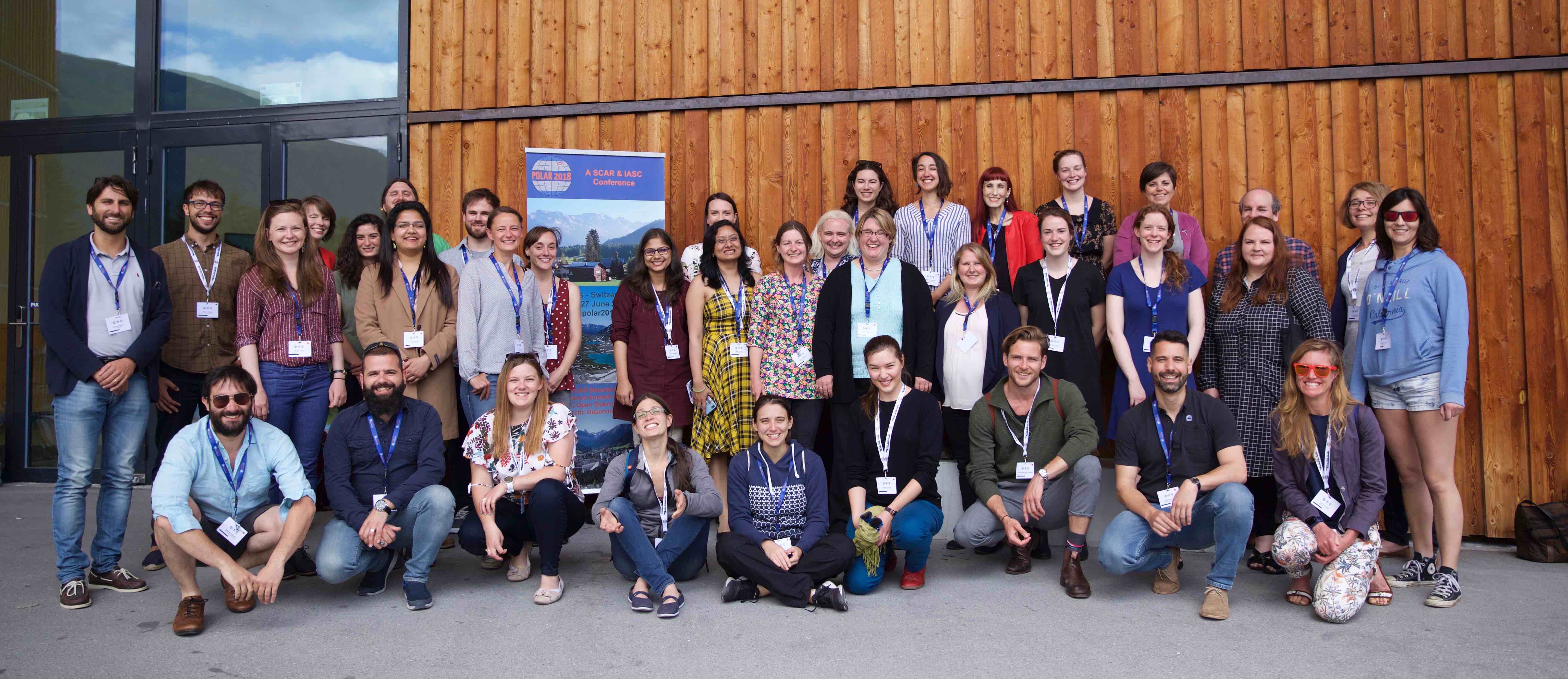
Picture: APECS Leadership and National Committee members at the APECS World Summit in June 2018.
13
Meeting Notes
The APECS Council is meeting every two months and you can find their meeting minutes posted here. So if you are interested in what the Council does, check this page regularly.
© Fiona Tummon, Francisco Fernandoy, ECMWF, Cynthia Sassenroth
5
International Directorate
The APECS International Directorate is the essential coordinating body without which the organiszation and running of the various APECS activities and programmes would hardly be possible. APECS is grateful for the continued support provided by its Directorate sponsors. Our current locations and sponsors are:

Directorate location:
The APECS International Directorate is currently located at the The University of Tromsø – The Arctic University of Norway (UiT) in Tromsø, Norway and is generously funded by the UiT, the Norwegian Polar Institute and the Fram Centre with two positions (a full-time Executive Director and a part-time Administrative Assistant) as well as operational expenses for the APECS office. The current funding agreement is in place until 2027.


 In addition, part-time project officer positions are funded at the Alfred Wegener Institute, Helmholtz Centre for Polar and Marine Research (AWI) in Germany through
- the EU Horizon 2020 project Arctic PASSION (Pan-Arctic Observing System of Systems: Implementing Observations for Societal Needs), July 2021 - December 2025



Find out more about our APECS International Directorate Sponsors as well as the organizations that have supported our office in the past and further partners and sponsors.
Mail address:
UiT Norges arktiske universitet
Universitetsbiblioteket – Kultur- og samfunnsfag
c/o Sarah Strand, APECS
Postboks 6050 Langnes
9037 TROMSØ
Physical address:
APECS International Directorate
UiT The Arctic University of Norway
Universitetsbiblioteket – Kultur- og samfunnsfag
Huginbakken 14
9019 Tromsø
Norway
Email: This email address is being protected from spambots. You need JavaScript enabled to view it.
Current staff members:
1
Advisory Committee
© Fiona Tummon, Francisco Fernandoy, ECMWF, Cynthia Sassenroth
APECS would like to thank the many members of the Polar Research Community that have agreed to serve as members of our Advisory Committee. Their opinions and input during these early stages of our organizational development are critical. It is also imperative that as young researchers we are guided by senior researchers with valuable wisdom to help our organization grow and our members pass through the stages of professional development that are often challenging.
If you are interested in serving on the Advisory Committee or know someone who would be a great asset, please This email address is being protected from spambots. You need JavaScript enabled to view it..
1
APECS Norge
The Association of Polar Early Career Scientists (APECS) is not a legal entity in its own right but an international network. Its APECS International Directorate is a project funded by the Research Council of Norway, the UiT The Arctic University of Norway and the Norwegian Polar Institute, and hosted by the UiT the Arctic University of Norway in Tromsø, Norway. The office can apply for additional projects through UiT.
Furthermore, the "Association of Polar Early Career Scientists Norge (APECS Norge)", a registered non-profit organization (#995238586) based in Norway was set up to receive and distribute donations and other income for APECS. APECS Norge has as main activity to be a local supporter of young polar researchers in Tromsø. The association consists mainly of experienced researchers with an interest in supporting recruitment to the field in all respects. Association activities will be in accordance with the statute:
- assisting with advice from experienced polar researchers on actions and activities conducted by APECS
- assist the Director in APECS with help in their daily work.
- Receive and distribute donations and income to APECS by current guidelines for donations / income
The APECS Norge has a Board of Directors consisting of 5 members.
2
Project Groups
Project groups are small working groups led by Project Group Leaders. Ideas such as Polar Weeks, the APECS Mentorship Award, and the many workshops and panel discussions, have all started with a few talented people working together with a specific aim - to help each other and to create a better way to conduct polar research and to help others learn about it. APECS Project Groups are how new ideas become reality. If you see a group here which you would like to contribute to, or indeed to set up a new one, please contact This email address is being protected from spambots. You need JavaScript enabled to view it..
Please register here if you would like to join one of the APECS Project Groups listed below.
© Fiona Tummon, Francisco Fernandoy, ECMWF, Cynthia Sassenroth
3
National Committees
APECS has many different groups to get involved with, and for many people connecting with other young researchers in their own country is a first step to meeting new colleagues and getting involved. Some countries have well developed APECS National Committees, some are just getting started - and others are just a mailing list of all the APECS members in that country. Below is more info on these groups, including how to contact them...
...if you don't see your country here, be sure to check out the article at the end of this page that provides some ideas on how to start your own national committee.
© Fiona Tummon, Francisco Fernandoy, ECMWF, Cynthia Sassenroth
2
Representatives
There are many great opportunities for early career researchers (ECRs) to advance their careers, learn from senior mentors, and help include the view of other ECRs into international science planning bodies. APECS actively encourages our partner organizations to include ECRs on their committees, meetings, and projects.
Type of roles:
- APECS representative: the ECR will officially represent APECS as an organization and will contribute an APECS perspective to the discussion(s) on the committee / meeting / project. For these positions, experience in APECS leadership is typically required. These opportunities may involve making a presentation or other material on behalf of APECS, and for that reason, it is in the best interest of APECS to select an individual in the APECS leadership who is familiar with the current activities and priorities of the organization. As an APECS representative, one is expected to express the views and priorities of APECS. Any personal opinions must be explicitly indicated as such, and the needs and goals of APECS take precedent over the opinions of the individual.
- ECR participant: the ECR will not officially represent APECS, but will participate in the committee / meeting / project as an individual providing their own perspectives as an ECR to the discussion and learn from the work on the committee. For these opportunities, APECS leadership experience is not required, though APECS membership is usually necessary to hear about the opportunity.
Role of the ECR: They can be a meeting observer, committee member or rapporteur providing an early career perspective to discussions, advocating for ECRs, taking on action points, helping to organize workshops and much more! It all depends what that particular partner organisation is looking for. Any confidential information discussed at the committee / meeting / project will not be included in any report the APECS representative or ECR participant will write about the meeting. Partners have at any time the right to ask the ECR to leave the discussion while confidential information is discussed. Above all, the idea is that the partner organization benefits from having input from an ECR, APECS benefits by working with and hearing news from that partner organization, and the ECR benefits by gaining experience and networking connections!
APECS helps our partner organizations to recruit both APECS representatives and ECR participants.
If you are an organization who would like to have an early career researcher on their committee, contact This email address is being protected from spambots. You need JavaScript enabled to view it. so we can help you arrange this.
© Fiona Tummon, Francisco Fernandoy, ECMWF, Cynthia Sassenroth
38
Meeting Summary from Representatives
APECS is happy to be able to link early career researchers with organisations interested in the polar regions, and whenever possible APECS sends a APECS representative to meetings on interest.Although we can usually only send one APECS member to a meeting, it is our goal to share information meetings and workshops with our wider membership.
In this section you will find the reports and summaries submitted by our APECS reps in order to share meeting topics and outcomes with our wider membership. You can also see them in the APECS News.
© Fiona Tummon, Francisco Fernandoy, ECMWF, Cynthia Sassenroth
3
Current Representatives
 APECS works with several international partners to create opportunities for APECS members and early career researchers in general to get involved in international committees, workshops and meetings, or to be co-conveners for sessions at international conferences. This can be either for one meeting or a longer period of time as part of a committee or working group. APECS would like to thank all of our partners for offering these opportunities for early career researchers and for helping to support the career development of this next generation of Arctic and Antarctic leaders in research. The list international opportunities for early career researchers that APECS helped appoint since 2016 is below.
© Fiona Tummon, Francisco Fernandoy, ECMWF, Cynthia Sassenroth
Will be updated soon...
4
Partners and Sponsors
APECS has been fortunate to work with organizations with similar goals and objectives for supporting young researchers. We thank our Partners and Sponsors for working with us to support our events and activities activities and give great opportunities for young researchers to advance their careers and portfolios. Partners and sponsors that want to stay informed about APECS activities can sign up for our mailing list here http://eepurl.com/brHpyn
© Fiona Tummon, Francisco Fernandoy, ECMWF, Cynthia Sassenroth
0
APECS Materials
13
APECS Videos
Check out our video archive for videos about APECS. Are you looking for webinars? You can find all APECS webinars in our webinar archive.

1
Support APECS
© Fiona Tummon, Francisco Fernandoy, ECMWF, Cynthia Sassenroth
1
Contact Us
© Fiona Tummon, Francisco Fernandoy, ECMWF, Cynthia Sassenroth
5
APECS International Directorate: Call for Bids 2021
Call for Bids
to host the International Directorate
of the Association of Polar Early Career Scientists (APECS)
Who we are: The Association of Polar Early Career Scientists (APECS) is an international and interdisciplinary organization for undergraduate and graduate students, postdoctoral researchers, early career faculty members, educators and other professionals interested in the Polar and Alpine regions and the wider cryosphere. We are a dynamic community that provides a platform for promoting collaborations and exchange among its members and with the wider Polar research community, endeavouring to create a continuum of leadership in polar sciences. The international and transdisciplinary collaboration APECS is providing, has been proven especially important in challenging times of social distancing.
What we are looking for: A host and sponsor(s) for our International Directorate Office starting January 2022. APECS is open to having either:
- One secretariat location with one or more institutions hosting and providing support for at least 1.5 staff positions; or a
- A dispersed secretariat option with:
- the main full-time staff position (Executive Director) being hosted / funded by one or more institutions in one location;
- support-position(s) (part-time or full-time) being hosted and funded by other institutions / countries in another location
Bids can be sent in from institutions interested in being:
- a host and sponsor of the International Directorate Office
- a partial sponsor (but no hosting) of the International Directorate Office
- a host and sponsor of a sub-office of the International Directorate
- a partial sponsor (but no hosting) of a sub-office of the International Directorate
What is in for you: Ensure the future of polar research and demonstrate your commitment to the development of early career researchers by helping APECS shape the Future of Polar Research. The APECS International Directorate helps boost the reputation and international profile of its host organization. At our current host institution AWI, APECS is involved in three EU projects, providing a substantial amount of overheads. Third-party funding like this will not only provide additional financial support but also visibility and the international standing of the host institution.
With a network spanning more than 76 countries with more than 3,800 members, APECS’ activities have global reach. If you reach out to the PhD students and Postdocs of your institute, there is a good chance that they are in APECS and can tell you how APECS is helping them. We also actively engage with the host organizations and other local stakeholders and have a strong focus on outreach in the local area. Our Annual Reports provide you with a sense of the variety of activities organized by APECS members.
Call process: We appreciate receiving expressions of interest until 31 March 2021. The deadline for bids is 31 May 2021.
Submission of Bids: Proposal should be sent as ONE PDF file in the attachment to the APECS Executive Director Dr. Josefine Lenz at This email address is being protected from spambots. You need JavaScript enabled to view it..
Please note that we accept proposals until negotiations are completed and the potential host has received a positive vote by the APECS Leadership. A decision will be announced as soon as the negotiations with the prospective new APECS International Directorate host and all sponsors are completed.
While APECS is open to considering a variety of institutional arrangements, it does expect a particular commitment of institutional resources to the International Directorate and its staff. APECS is anticipating arrangements with a new organizational host of at least 3 years, and preferably of 5+ years. The APECS Executive Committee will work together with the host institution on the hiring of the new APECS Executive Director. Please review details and guidelines for proposals below.
If you have questions please contact the APECS Executive Director Dr. Josefine Lenz at This email address is being protected from spambots. You need JavaScript enabled to view it..
List of accompanying documents:
- Appendix 1: About APECS and its International Directorate
- Appendix 2: Expected support from an APECS International Directorate host institution
- Appendix 3: Optional: Expected support from a Sub-Office host institution
- Appendix 4: Detailed Guidelines for Proposals for hosting the APECS International Directorate or a Sub-Office
- Appendix 5: Evaluation Criteria of Bids
0
Publications
We all know that publications are the 'currency' of science and research. APECS is very conscious of this and is making an effort to encourage young researchers involved with organizing our activities to publish papers, present activites and results at conferences, and help to share the great things we are doing with the rest of the science community and the general public.
© Fiona Tummon, Francisco Fernandoy, ECMWF, Cynthia Sassenroth
1
APECS Handbook
© Fiona Tummon, Francisco Fernandoy, ECMWF, Cynthia Sassenroth
1
Annual Reports
APECS publishes an Annual Report every year to highlight our activities, projects and events that happened during the year.
0
Newsletter Archive
 If you want to catch up on the latest things APECS has been doing, reading our newsletters is the perfect way to see all the highlights of our organization and our member's activities. We archive our monthly newsletter on this page. Enjoy reading it!
Articles and events posted to the APECS News, Partner News and Polar News as well as the Event List are included in the APECS Newsletter. The APECS Newsletter is published monthly in the last week of the month. Articles and events have to be posted on the news pages before the 20th of each month to be included in the newsletter issue of this month. Articles posted after that will be moved into the newsletter edition of the following month. If you have questions about our newsletter, contact This email address is being protected from spambots. You need JavaScript enabled to view it.
© Fiona Tummon, Francisco Fernandoy, ECMWF, Cynthia Sassenroth
2
Get Involved

APECS has many opportunities for our members to get involved in our network. Career development, education and outreach, mentoring, and networking all play a role in making APECS a valuable organisation, both for early career researchers (ECRs), and for the wider polar community - the video presents a taste of each, and showcases the many opportunities and successes that have been made possible thanks to the tireless work of ECR volunteers. Hopefully this video and the all the information we have available on the APECS website will exlain not only what we do but also give you ideas how YOU can get involved in APECS!
1
Social Media

Are you active on social media? So is APECS! We are always looking to share exciting activities and updates from our members, project groups, and national committees on our APECS accounts on Facebook, Instagram, Twitter, and LinkedIn. If you have any information you'd like to share, simply upload your text and photos to our easy-to-use Google Form, and we'll get to it as quickly as possible. Alternatively, if you have a broader social media campaign you're interested in running or wish to promote a specific event your council or NC is running, feel free to get in touch with the APECS Social Media Coordinators, Anika Happe, Anastasia Deyko, Dan Grafton and Kimberly Montañez-Medina, at This email address is being protected from spambots. You need JavaScript enabled to view it..
We are looking to post regularly on behalf of APECS, from special events to other updates, social gatherings, articles you might want to share with others, and more. So help us by sending us your news!
In the meantime, we'd love it if you could follow APECS on the following accounts:
 |
Facebook: https://www.facebook.com/APECS4u/ |
 |
Twitter: @Polar_Research |
 |
Instagram: @apecs.polar |
 |
LinkedIn: APECS group: https://www.linkedin.com/groups/3380771/ APECS profile: https://www.linkedin.com/in/polar-research-3845b44b/ |
Feel free to tag us in your posts too at the above accounts or with the hashtags #APECS and #APECS2022.
We look forward to staying in touch through the web!

8
Events

© Deniz Vural, Jilda Caccavo, Mariama Dryak, Cynthia Sassenroth, Matias Ricardo (left to right)
|
Some upcoming APECS event highlights that have their own pages on the APECS website. Find out more ... |
||
|
Check our Polar and Alpine Events Calendar for announcements about upcoming:
|
||
| Here you can find the archived pages and reports of past APECS event highlights. | ||
| Do you want to organize an APECS workshop, panel or webinar? You can find some tips and tricks on how to organize your event here. |
If you have any questions or want to advertise an event via our Polar and Alpine Events Calendar, This email address is being protected from spambots. You need JavaScript enabled to view it.
0
Upcoming Event Highlights
© Deniz Vural, Jilda Caccavo, Mariama Dryak, Cynthia Sassenroth, Matias Ricardo (left to right)
By bringing together polar scientists with diverse range research interests and levels of expertise, APECS events are a great way to keep up to date on cutting edge science, foster collaborations, and forge new research partnerships and even friendships. Here we list announcements for upcoming larger APECS workshops and events you can participate in to broaden your knowledge of polar science and grow your research network.
Upcoming APECS event highlights that have their own pages on the APECS website, you can find the links below.
Check our Upcoming Polar and Alpine Events for other announcements about other upcoming
- Online APECS Events
- APECS Panels, Workshops and Meetings
- General Polar Conference and Meetings
- Field and Summer Schools
For information on past APECS events, refer to the past APECS Event Highlights.
If you have a suggestion for an event you would like to see APECS host, or would like to be involved in organizing a future APECS event, please contact us at This email address is being protected from spambots. You need JavaScript enabled to view it..
3
APECS International Polar Week September 2022

APECS International Polar Week is a traditional APECS event held twice a year during the equinoxes (March and September), that is, the dates when the Sun is exactly above the Equator, making day and night of approximately equal length in the northern and southern hemispheres. This is a celebration of the polar and alpine regions with the aim of increasing interest and knowledge about these regions.
The next international polar week will take place between 26-30 September 2022 and on these dates, we want to engage students, researchers, educators and everyone interested in the polar regions to share experiences and curiosities at a series of events around the world.
We are planning to cover several topics during the week including the Arctic, Antarctica and Alpine regions, the importance of polar regions for climate change, polar art and polar engineering.
Together with APECS National Committees and the APECS Project Groups, we invite everyone to take part in this important celebration! Join us in celebrating the upcoming Polar Week from 26-30 September 2022 with the activities:
- USAPECS Polar Film Festival
- short story/essay competition
- ... and more with APECS NCs and PGs.
- more activites will be posted shortly
© Designed by Juliana Souza-Kasprzyk
3
APECS International Online Conference 2022

APECS International Online Conference 2022: All hands on deck!
Inclusive knowledge on polar regions as a pathway for sustainable future
The idiom “All hands on deck” reflects the efforts that are currently needed to address the major environmental challenges of the current century. Knowledge in all forms and of all natures represent an essential component for designing a desirable and sustainable future both for Mankind and the Earth, along with the means to achieve such horizons. Knowledge inclusiveness, however, has not always been a concern in scientific and academic circles, although this could improve the ways we do research and interact with the rest of the society.
For the 2022 edition of its International Online Conference, the Association of Polar Early Career Scientists (APECS) has thus chosen to dedicate a 24-hour online conference, on 18 May 2022, for sharing experiences and knowledge on Polar and Alpine regions from various perspectives.
The conference contains five sessions drawing on multiple disciplines from the social to the natural sciences:
- Polar regions in motion
- Advances in cryospheric sciences
- Voices from Alpine and Polar regions
- Methods and ethics in polar research
- Bridging knowledge from Polar ocean beneficiaries
We decided to make natural, humanities and social sciences meet in three of the five sessions (i.e., bridging knowledge from Polar ocean beneficiaries; polar regions in motion; methods and ethics in polar research) and retained transversal, open themes so as to allow a wide array of discussions. We also dedicated sessions to particular realms such as the ocean, the coasts and the cryosphere.
The APECS International Online Conference 2022 is proud to be an Ocean Decade endorsed activity.
2
Antarctica Day

Antarctica Day is celebrated by the international polar community on 1st December to commemorate the signing of the Antarctic Treaty in 1959, which is considered to be one of the most successful achievements of the international community. We enthusiastically encourage our members to organize activities and to communicate with us if you are planning something special to celebrate Antarctica Day.
3
APECS International Online Conference 2023

The Association of Polar Early Career (APECS) is pleased to announce the 9th annual APECS International Online Conference to be held on 10-11th Oct. 2023. APECS has been creating opportunities for the development of an international and transdisciplinary network for promoting education and outreach in polar research and is celebrating its 15th year of service. The Svalbard Integrated Arctic Earth Observing System (SIOS) is an important partner of APECS. In 2023, the 9th edition of the APECS International Online Conference 2023 aims to shed light on the various roles assumed by APECS and its supporting organizations in an opening session while critically discussing the challenges and opportunities in cryospheric sciences. Subsequently, the theme of the conference this year is “Challenges and Opportunities in Cryospheric Sciences: 15 Years of APECS!”
0
Organising APECS Events
APECS and its National Committees and Project Groups organise in-person (e.g. workshops, panel discussions, networking events) as well as online events (e.g. webinars) for ECRs regularly around the world. Many of them you find listed in our event list. And you can help us too! If you want to participate in organising an event that APECS is planning or if you have an idea for an event you want to organise, contact This email address is being protected from spambots. You need JavaScript enabled to view it. or fill in the form for upcoming APECS Events.
On this page, you can find some resources and advice for planning APECS in-person and online events that might be helpful to you about planning.
--> BEFORE YOU ORGANIZE OR PARTICIPATE IN AN ONLINE EVENT PLEASE MAKE SURE TO SIGN THE LETTER OF INDEMNITY!
© Deniz Vural, Jilda Caccavo, MariamaDryak, Cynthia Sassenroth, Matias Ricardo (left to right)
0
Mentors

Since its inception, APECS activities have aimed to help provide a continuum of knowledge in polar and cryospheric research. We are very grateful to the many senior researchers and professionals that have served as mentors for our many activities.
You are a non-early career scientist / professional and want to be updated on APECS activities? You can choose to either register for full APECS membership or you can register for the mailing list for non-early career scientists and professionals and select which types of announcements you wish to receive.
3
APECS International Mentorship Award
APECS seeks to recognize and honor the efforts of its mentors within the international polar scientific community. The APECS Mentorship Award is designed to recognize the time and energy that mentors devote to Early Career Researchers (ECRs) each year, and their efforts to build a community of support. APECS will award a mentor who works with the ECR polar scientific community, including Arctic, Antarctic, and Alpine areas, as well as the wider cryosphere.
See our past award recipients here.
8
Award Recipients
APECS International would like to recognize and honor the efforts of their mentors within the international polar science community. The APECS International Mentorship Awards were established in 2016 as a meaningful way to recognize the efforts of mentors within the international polar science community, and to honour those who have devoted significant time and energy towards building a supportive community for early career professionals.
Recipients of the APECS International Mentorship Award are:

0
Career Resources

© Allen Pope, Allen Pope, Neelu Singh, Elizabeth Erickson, Ribanna Dittrich
Providing the opportunity for career development for both traditional and alternative polar and cryosphere professions is one of the main goals of APECS. We therefore have compiled a number of career development resources on our website. If you have suggestions for improvements of the existing resources or if you can think of a resource that should be added please email This email address is being protected from spambots. You need JavaScript enabled to view it. . In our "Career Resources" website section you will find the following information:
0
Tips For Conferences
© Allen Pope, Allen Pope, Neelu Singh, Elizabeth Erickson, Ribanna Dittrich
We all know that one of the most important parts of establishing a successful science career (or any career for that matter) is the network of colleagues you create. Conferences are a great way to meet people – you share ideas, develop new projects, learn new techniques, find your next employer or employee, and sometimes even have a little fun. This section of the APECS website is dedicated to helping you navigate conferences – from writing an abstract about your work, designing your oral or poster presentation, finding travel funding, serving as a session convener/chair or on a committee, organizing a side workshop or panel – there lots of things you can do and opportunities to take advantage of to start building a great network of colleagues around the world.
Be sure to check the Event listings on the APECS website to find upcoming conferences that may be of interest to you.
If you have tips to share, ideas of other things we should include, or other meeting you know about that are not on our list, This email address is being protected from spambots. You need JavaScript enabled to view it..
Useful Things to Know about Conferences
4
Abstracts
When preparing to share your research at a conference, you often have to write an 'abstract'. What is an abstract anyways and how can I write a good one? Here are some tips on abstracts for conferences and other resources that might be helpful.
2
Presentations
Making sure you clearly and concisely share your research with others is often a challenge. Giving a conference presentation, whether as an engaging talk or a beautiful poster, takes practice and a little extra work. Here we share with you some resources on designing your posters and presentations, as well as how to best use the time you have with people while discussing your research.
3
Sessions
Whether you are deciding what session or area to submit your abstract to or helping to organize a session where other scientists can present their work to colleagues working on similar things, there are lots of things that go into planning a session at a conference. Being a session leader, often called a convener or chair, is an important responsibility that can introduce you to the latest research happening in your field and help you meet new colleagues and develop partnerships. Here we provide some guidance to those of you interested in taking on this leadership role.
0
APECS Webinars
© Allen Pope, Allen Pope, Neelu Singh, Elizabeth Erickson, Ribanna Dittrich
APECS works with mentors and partners to develop webinars to assist APECS members and other early career scientists with their career development goals as well as to highlight current Polar Research. The webinar audience consists of graduate students, post-docs, and early career faculty across many disciplines. Since its inception in 2010, thousands of people from around the world have participated in the webinars.
-
How to Participate in a Webinar?
Participation in the webinars is open to all and completly free. If you have not participated in an online webinar before, its actually not as difficult as it may seem, and we can help you every step of the way. To attend a webinar you just need your computer or smartphone and an internet connection. We only use VOIP, so no telephone is required. We are not using webcams, so you can participate in your pajamas!
Check out the upcoming webinars. If you see a webinar you would like to join, click the link to the right of the webinar to register for it. If the webinar is in session, the link will take you right to webinar in session. If the webinar has not yet begun, you can register for the event. Registering for the webinars ahead of time is a good idea because you will automatically recieve an email with instructions and reminders 1 day and 1 hour before the event.
If you have any questions, potential topics, or potential presenters to suggest, please contact at This email address is being protected from spambots. You need JavaScript enabled to view it..
0
Non-Academic Careers
© Allen Pope, Allen Pope, Neelu Singh, Elizabeth Erickson, Ribanna Dittrich
As part of our goal to keep early career researchers informed of all their options in career development, we have created a “Non-Academic Career Information” website section under the umbrella “Career Resources”. Here you can find information about how to take your career trajectory outside of the traditional academic mold via various resources:
10
Researcher Profiles
Not all non-academic career researchers started out as such, and their paths are as diverse as the exciting work that they do. The researcher profiles featured here consist of a series of short bios and interview responses that help to illustrate the myriad ways in which one can become involved in a non-academic career path, as well as what those careers might entail.
3
Archived Webinars
The archived webinars provide additional perspectives and advice on non-academic careers and transitions to alternative careers. Additional webinars will be added periodically and suggestions for additional webinars to add are welcome.
0
Diversity-Equity-Inclusion
© Allen Pope, Neelu Singh, Elizabeth Erickson, Ribanna Dittrich
The APECS Diversity, Equity and Inclusion (DEI) Project Group aims to ensure that one’s identity is not a barrier to success in polar science. Our specific goals are to:
- Facilitate international and interdisciplinary dialogue around diversity, inclusion, and equity in the polar science community;
- Provide resources for APECS members facing identity-related challenges, as well as bystanders, allies, and leaders in our communities;
- Ensure that the values of diversity, inclusion, and equity remain embedded in APECS and related communities now and in the future.
Each of the terms “diversity,” “inclusion,” and “equity” has a specific and important meaning. The following definitions are based on current research and applied for work in the field.
-
Diversity
Diversity is the presence of a variety of individual identities within a particular setting. Diversity may be based on race, ethnicity, sex, gender, sexual orientation, socioeconomic status, language, culture, nationality, language, religious beliefs, age, career status, physical appearance, disability status, and other identity markers. Individuals and groups often affiliate with multiple, intersecting identities. -
Inclusion
Inclusion is the act of creating an environment in which any individual or group feels welcomed, respected, and valued. An inclusive group is by definition diverse, but a diverse group is not necessarily inclusive: the creation of an inclusive environment requires attention to the experience of individuals from diverse backgrounds and the challenges they face1. Inclusive organizations must actively combat harassment, assault, implicit bias, and other aspects of exclusionary cultures through bottom-up and top-down efforts.
1In case the distinction is confusing, a simple way to think about this is that “Diversity is being asked to the party. Inclusion is being asked to dance.” - Verna Myers, inclusion strategist.
-
Equity
Equity refers to the process of ensuring that everyone has equal access to opportunities. Equity recognizes that not all members of a group or community start from the same place, have equal access to resources, or have equal paths to advancement. Therefore equity requires ensuring all members have what they need to be successful. In this way equity differs from equality, which implies treating everyone the same, regardless of their needs. Diverse, inclusive environments benefit members only if they are also equitable environments within which everyone has truly equal access to resources and opportunities. Like inclusion, equity requires actively combating harassment, assault, implicit bias, and other aspects of exclusionary cultures through bottom-up and top-down efforts.
This project group emphasizes that diverse, inclusive, and equitable environments benefit polar research overall, which is strengthened by contributions from diverse participants (diversity), especially when participants are welcomed and not subject to discrimination (e.g., through harassment, assault, or bias) (inclusion), and when all participants have sufficient resources and access to contribute at all levels of polar research (equity)
Source: United Nations System Staff College; Independent Sector; University of Michigan Institute for Social Research; London School of Economics: Equity, Diversity and Inclusion; and The Diversity Collegium, via UN Global Compact.
1
Collaborations Guide
© Allen Pope, Allen Pope, Neelu Singh, Elizabeth Erickson, Ribanna Dittrich
We present here a ‘Guide for Fruitful Collaborations’. This guide is a result of a yearlong effort by an Association of Polar Early Career Scientists (APECS) Project Group called Collaboration Guide, that spent the 2018/19 term collecting necessary data, and inquiring among APECS National Committees and Council members. Through this process we learned about and documented their experiences. We offer this guide in the hope that it will inform and enhance future collaborations. As a result we present a concise overview of the main aspects of collaborations starting with the basics:
- an introduction to collaborations; and
- the types of collaborations APECS members engage in?
Then, we outline key strategies for :
- initiating collaborations,
- maintaining, and
- ending collaborations in ways that aid in the endeavors of all APECS members.
We finish the guide with one providing direct insight into the process of collaborating. We express our sincere gratitude to all those who have contributed to this work, without whom this guide could have not been created.
0
Research

@ Tayana Arakchaa, Ruth Hindshaw, Iglika Trifonova, Caroline Coch, Victorio Maximiliano Rocchi (left to right)
One of the goals of APECS is to create a network of polar researchers across disciplines and national boundaries to meet, share ideas and experiences, and develop new research directions and collaborations. Our members represent all natural and social sciences research disciplines involved in research in the Polar and Alpine regions and the wider cryopshere.
2
Data Management
APECS is beginning an effort to help you figure out how to deal with all the data that you collect - and how to plan the management of this data before you actually collect it. We know there is a lot of things to know about data, and sometimes it can get a little overwhelming, with the help of the IPY Data Committee and others, we are hoping to design several training activities to help you learn about this important and critical part of research.
@ Tayana Arakchaa, Ruth Hindshaw, Iglika Trifonova, Caroline Coch, Victorio Maximiliano Rocchi (left to right)

0
Projects
@ Tayana Arakchaa, Ruth Hindshaw, Iglika Trifonova, Caroline Coch, Victorio Maximiliano Rocchi (left to right)
This section highlights the APECS involvement in longer-term projects funded by various funding sources. Some projects were initiated by APECS and in others APECS is involved as a partner responsible for certain tasks related to the training of early career researchers, education and outreach. The current ongoing projects you can see listed below.
1
ARICE
ARICE - Arctic Research Icebreaker Consortium
Project Duration: 2018 - 2022
The recent changes of the Arctic and the resulting increased economic activity in the region have triggered a societal demand for accuratesea-ice and weather predictions, information on the status of the Arctic Ocean and its marine life, and complex predictions of future scenarios. To address these issues and to develop policy recommendations for a sustainable usage of the Arctic Ocean and its resources, the international Arctic science community must have access to world-class research icebreakers to access the ice-covered Arctic Ocean.
Currently, the lack of available research icebreakers from Europe and beyond that can operate yearlong in the ice covered Arctic Ocean, and a weakly coordinated polar research fleet impedes Europe’s capacity to investigate the changing Arctic. There is thus an urgent need for providing polar scientists with better research icebreaker capacities for the Arctic, to address the knowledge gaps and to develop policy recommendations for a sustainable usage of the Arctic Ocean and its resources.
This need has now been taken up by the EU funded Arctic Research Icebreaker Consortium (ARICE).
Find out more about ARICE on the project website: https://arice-h2020.eu
 ARICE has received funding from the European Union’s Horizon 2020 research and innovation programme under grant agreement No. 730965.
6
Online Technical Training Programme
 In April/May 2021, APECS and the Arctic Research Icebreaker Consortium organized an Online Technical Training. The aim of the training modules was to offer early career researchers and professionals insights into technical aspects of ship-based polar research and share knowledge and new developments of technical instruments and equipment used on icebreakers and polar research vessels in ice-covered waters.
Six exciting training modules were taught by experts in engineering, technical and scientific practitioners, covering topics of marine robotics, atmospheric measurements, mooring operations, laboratory work on a moving ship and best practices in technical science support. The course was attended live by both, scientists and technical professionals.
All workshop video recordings are now available online on the APECS vimeo channel and below.
For more information, please contact APECS Project Officer Boris Radosavljevic or the APECS Office.
1
INTERACT
 INTERACT - International Network for Terrestrial Research and Monitoring in the Arctic
Project Duration Phase II: 2016 - 2020
Project Duration Phase III: 2020 - 2023
INTERACT is an EU Horizon 2020-funded infrastructure project of terrestrial research stations throughout the Arctic and adjoining forest and alpine regions. The project builds on the SCANNET network of field stations situated in all eight Arctic countries.
 INTERACT brings together an advanced community to build capacity for identifying, understanding, and responding to diverse environmental changes throughout the Arctic and adjoining regions. The project provides a long-term legacy by mentoring and educating the next generation of researchers as well as by providing a one-stop-shop for provision of northern data and services. INTERACT brings together station managers, technology development experts, the scientific community as well as major international organisations and educational establishments, providing a well-balanced and truly integrated circumpolar network.
Trans-national access is provided through INTERACT to provide opportunities for researchers from Europe and beyond to carry out research at the more than 80 terrestrial stations that are part of the network. In return, the improved access has led to more collaboration, better measurements across more regions, new research directions at individual stations, and much improved capacity across the network.
Find out more about INTERACT on the project website: https://eu-interact.org
INTERACT has received funding from the European Union’s Horizon 2020 research and innovation programme
2
INTERACT Station Videos
 APECS is involved in the EU Horizon 2020-funded INTERACT (International Network for Terrestrial Research and Monitoring in the Arctic) project. One of our tasks has been to produce example introductory videos of some of the INTERACT research stations. These videos are there to provide a brief introduction to each research station, what facilities are available, what research is carried out there, and other general information about the area.
Find out more about on the INTERACT website.
1
Arctic PASSION
Arctic PASSION: Pan-Arctic Observing System of Systems: Implementing Observations for Societal Needs
Project Duration: 2021-2025
Arctic PASSION is an EU-funded Horizon 2020 project that aims to co-create and implement an Arctic observing system that is tuned to address the urgent needs of people living in the Arctic and that has relevance to the global society.
A coherent integrated pan-Arctic Observing System of Systems shall monitor ongoing environmental changes, reduce uncertainty in predicting future system changes, as well as give support for risk assessment, mitigation and adaptation measures. The high-quality Earth observation information will be unrestricted available and serve as the basis for evidence-based economic, policy, investment and management. That all strengthens the societal decisions we make for a safe, sustainable and prosperous Arctic.
To achieve this, the holistic Arctic PASSION project brings together researchers, stakeholders, local and indigenous communities, economy and governments.
Learning from each other and integrating all knowledge will let us take the next step towards a sustainable development in the Arctic and globally.
Find out more about Arctic PASSION on the project website: https://arcticpassion.eu/
Arctic PASSION has received funding from the European Union’s Horizon 2020 research and innovation programme.
5
Polar and Alpine Research Areas
The number of research topics covered by Polar and Alpine research is vast and our members are involved in both natural and social sciences disciplines. The aim of this page is to provide someone new to the topic an overview of research areas involved in Polar and Alpine research and provide a snapshot of some disciplines that are being researched by APECS members.
We know that the topics you'll find in this page do not reflect the full breadth of Polar and Alpine research! If you are missing a discipline, please contact This email address is being protected from spambots. You need JavaScript enabled to view it. and send us a short description for it.
@ Tayana Arakchaa, Ruth Hindshaw, Iglika Trifonova, Caroline Coch, Victorio Maximiliano Rocchi (left to right)
0
Virtual Posters
3
Virtual Poster Session 2010 - 2012
 This effort focuses on bringing the concept of the poster presentation beyond the four walls of the conference halls and creates an online database of polar research poster publications. This project allows members with similar goals and interests to exchange information and assures a platform for the exchange of Arctic, Antarctic and Cryospheric research, policy, and education activities that are Shaping the Future of Polar Research. APECS is leading an effort towards e-conferences among polar researchers where participants can present their research findings to an international audience through web-based settings using the APECS website.
The APECS Virtual Poster Session was initially funded by the Nordic Council of Ministers' Arctic Cooperation Programme.
Share posters you have presented at other conferences, carry on discussions, get feedback from senior researchers in the field and also find new collaborators - Submit your Poster!
1
Academic Journals
Trying to figure out a journal to publish your next paper in? Want to find journals with polar research papers from another discipline? Just curious about what is all out there? Here we have put together a list of journals that specifically cover Polar Research topics. If you have additional ones to suggest, This email address is being protected from spambots. You need JavaScript enabled to view it..
@ Tayana Arakchaa, Ruth Hindshaw, Iglika Trifonova, Caroline Coch, Victorio Maximiliano Rocchi (left to right)
-
Advances in Polar Science
APS is an international, peer-reviewed and open-access journal sponsored by the Polar Research Institute of China (PRIC). It publishes achievements in fundamental research, applied research and high-technology research focused or based on the polar regions, and to report the latest discoveries, inventions, theories and methodologies in polar research. The scope of the journal covers a range of polar disciplines including glaciology, oceanography, atmospheric science, space physics, geology, geophysics, geochemistry, biology and ecology, medicine, Antarctic astronomy, environmental science and engineering and technology as well as polar social science, information service and management. APS also publishes occasional "Special Issues" on specific polar research themes. The "Opinion Editorial" category provides a forum to comment on the status and/or deficiencies of any aspect of polar science, to reflect on recent innovation or progress, and to promote internationally collaborative polar science projects.
Website: https://aps.chinare.org.cn -
Annals of Glaciology
The Annals of Glaciology are thematic volumes that contain selected papers from IGS sponsored or co-sponsored symposia. Papers are peer-reviewed and edited prior to publication. Recent Annals are available online to symposia participants and those who have subsequently purchased the hard copy of the Annals of Glaciology volumes.
Website: http://www.igsoc.org/annals/ -
Antarctic Science
Antarctic Science provides a truly international forum for the broad spread of studies that increasingly characterise scientific research in the Antarctic. Whilst emphasising interdisciplinary work, the journal publishes papers from environmental management to biodiversity, from volcanoes to icebergs, and from oceanography to the upper atmosphere. No other journal covers such a wide range of Antarctic scientific studies. The journal attracts papers from all countries currently undertaking Antarctic research. It publishes both review and data papers with no limits on length, two page short notes on technical developments and recent discoveries, and book reviews. These, together with an editorial discussing broader aspects of science, provide a rich and varied mixture of items to interest researchers in all areas of science. There are no page charges, or charges for colour, to authors publishing in the Journal. One issue each year is normally devoted to a specific theme or papers from a major meeting.
Website: https://www.cambridge.org/core/journals/antarctic-science
Editor-in-Chief: Peter Convey
Managing Director: Mariel Kieval -
Anthropological Papers of the University of Alaska (APUA)
Journal consisting of original papers on a variety of topics related to arctic or subarctic anthropology. Produced by the University of Alaska Fairbanks Department of Anthropology since 1951, APUA offers a collection of scholarly, often rare papers written by noted authorities in the field. During these past years the journal has normally appeared as two issues per volume under the direction of an editor assisted by two associate editors. Volume 25 is the last of the series that will be published in the original format.
Website: http://www.uaf.edu/apua/
Editor: Maribeth S. Murray -
Arctic
This American journal contains contributions from any area of scholarship dealing with the polar and sub-polar regions of the world. Arctic keeps its lectures informed of current thought and directions that cross disciplinary boundaries, enabling a broader understanding of today's rapidly changing circumpolar world.
Website: https://arctic.ucalgary.ca/about-arctic-journal
Editor: Karen McCullough -
Arctic, Antarctic and Alpine Research
AAAR consists of peer-reviewed, original research papers and reviews, resulting correspondence, opinion pieces, book reviews, memoriams, and an events calendar, all published in English. The journal covers any scientific or cultural aspect of arctic, antarctic, and alpine environments and related topics on subarctic, subantarctic, subalpine environments, and paleoenvironments. Papers may be uni- or multidisciplinary but should have interdisciplinary appeal. Special thematic issues and proceedings are published from time to time.
Website: http://aaarjournal.org/
-
Arctic Anthropology
Bi-annual international journal devoted to the study of Old and New World northern cultures and peoples founded in 1962 by Chester S. Chard. Archaeology, ethnology, physical anthropology, and related disciplines are represented, with emphasis on: studies of specific cultures of the arctic, sub-arctic and contiguous regions of the world; the peopling of the New World; relationships between New World and Eurasian cultures of the circumpolar zone; contemporary problems and culture change among northern peoples; and new directions in interdisciplinary northern research.
Website: https://uwpress.wisc.edu/journals/journals/aa.html
Editor: Susan Kaplan -
Croyshere
The Cryosphere (TC) is a not-for-profit international scientific journal dedicated to the publication and discussion of research articles, short communications, and review papers on all aspects of frozen water and ground on Earth and on other planetary bodies.
The main subject areas are ice sheets and glaciers, planetary ice bodies, permafrost, river and lake ice, seasonal snow cover, sea ice, remote sensing, numerical modelling, in situ and laboratory studies of the above and including studies of the interaction of the cryosphere with the rest of the climate system.
Website: https://www.the-cryosphere.net -
Etudes - Inuit - Studies
A biannual scholarly journal is published since 1977. The Journal is devoted to the study of Inuit societies, either traditional or contemporary, in the general perspective of social sciences and humanities (ethnology, politics, archaeology, linguistics, history, etc.). The Journal has grown to become a major crossroad of information on northern endeavours. As well as a number of articles, each volume contains book reviews, a list of scientific events, and annual reviews of recent theses and articles published in other journals. The articles are either in French or English.
Website: http://www.fss.ulaval.ca/etudes-inuit-studies/
Editor: Murielle Nagy -
Geophysical Research Letters
Publishes short, concise research letters that present scientific advances that are likely to have immediate influence on the research of other investigators. GRL letters can focus on a specific discipline or apply broadly to the geophysical science community.
website: http://www.agu.org/journals/gl/ -
Journal of Geophysical Research
Publishes original scientific research on the physical, chemical, and biological processes that contribute to the understanding of the Earth, Sun, and solar system and all of their environments and components. JGR is currently organized into seven disciplinary sections (Atmospheres, Biogeosciences, Earth Surface, Oceans, Planets, Solid Earth, Space Physics). Sections may be added or combined in response to changes in the science.
Website: http://www.agu.org/journals/jd/ -
Journal of Glaciology
The International Glaciological Society was founded in 1936 to provide a focus for individuals interested in practical and scientific aspects of snow
and ice.
Website: http://www.igsoc.org/journal/
Editor(s): T.H. Jacka -
Journal of Physical Oceanography
The journal publishes research related to the physics of the ocean and to processes operating at its boundaries. Theoretical and modeling studies are welcome, especially those that are linked to observations. Papers that investigate interactions with other components of the earth system (e.g., ocean-atmosphere, physical-biological and physical-chemical interactions) as well as studies of other fluid systems (e.g., lakes and laboratory tanks) are also invited, as long as their focus is on understanding the ocean.
Website: https://journals.ametsoc.org/toc/phoc/current -
Oecologia Australis
Oecologia Australis is edited by the Postgraduate Programme in Ecology of the Federal University of Rio de Janeiro (PPGE/UFRJ) and aims to publish reviews in Ecology. The target public of our journal is researchers and undergraduate and graduate students in Ecology and related areas.
The review papers may be submitted in Portuguese, Spanish or English and must contain an abstract in the same language in which the paper is written.
Oecologia Australis publishes four issues per year, two of which are thematic issues and contain review papers and case studies (original contributions). These thematic issues are edited by invited editors who coordinate all the editorial process, being responsible for the first evaluation of the papers submitted to the volume and for the assigning of each paper to two reviewers – in accordance to the criteria of the double-blind peer review policy adopted by the journal. Researchers can be invited to coordinate the editing process of a specific issue or can present spontaneous proposals for editing a thematic issue in their area of expertise.
The published issues of June and December are composed by review papers of unprompted submissions to the journal. The submission of these papers can be made during the entire year. Papers submitted before March 15th will be peer reviewed for the June issue and papers submitted before September 15th will be peer reviewed for the December issue.
Website: https://revistas.ufrj.br/index.php/oa/index -
Permafrost and Periglacial Processes
Permafrost and Periglacial Processes is an international journal dedicated to the rapid publication of scientific and technical papers concerned with earth surface cryogenic processes, landforms and sediments present in a variety of (Sub) Arctic, Antarctic and High Mountain environments. It provides an efficient vehicle of communication amongst those with an interest in the cold, non-glacial geosciences. The focus is on (1) original research based on geomorphological, hydrological, sedimentological, geotechnical and engineering aspects of these areas and (2) original research carried out upon relict features where the objective has been to reconstruct the nature of the processes and/or palaeoenvironments which gave rise to these features, as opposed to purely stratigraphical considerations. The journal also publishes short communications, reviews, discussions and book reviews. The high scientific standard, interdisciplinary character and worldwide representation of PPP are maintained by regional editorial support and a rigorous refereeing system.
Website: http://onlinelibrary.wiley.com/journal/10.1002/(ISSN)1099-1530 -
Polar Biology
Polar Biology publishes Original Papers, Reviews, and Short Notes and is the focal point for biologists working in polar regions. It is also of interest to scientists working in biology in general, ecology and physiology, as well as in oceanography and climatology related to polar life. Polar Biology presents results of studies in plants, animals, and micro-organisms of marine, limnic and terrestrial habitats in polar and subpolar regions of both hemispheres.
Website: http://www.springer.com/life+sci/ecology/journal/300 -
Polar Geography
Polar Geography is a quarterly publication that offers a venue for scholarly research on the physical and human aspects of the Polar Regions. The journal seeks to address the component interplay of the natural systems, the complex historical, political, economic, cultural, diplomatic, and security issues, and the interchange amongst them. As such, the journal welcomes comparative approaches, critical scholarship, and alternative and disparate perspectives from around the globe.
The journal offers scientists a venue for publishing longer papers such as might result from distillation of a thesis, or review papers that place in global context results from coordinated national and international efforts currently underway in both Polar Regions. The journal also offers a section for book reviews and invites such submissions or suggestions.
Website: http://www.tandf.co.uk/journals/tpog -
Polar Record
Polar Record is an international, peer-reviewed scholarly periodical publishing results from a wide range of polar research areas. The journal covers original primary research papers in the humanities, social sciences, physical sciences, life sciences, and polar technology, as well as papers concerning current political, economic, legal, and environmental issues in the Arctic or Antarctic. Polar Record endeavours to provide rapid publication, normally within nine months of initial submission.
Website: http://journals.cambridge.org/action/displayJournal?jid=POL
Editor(s): Ian R. Stone -
Polar Research
style="margin: 0cm 0cm 0pt;">Polar Research is the international, peer-reviewed journal of the Norwegian Polar Institute, Norway's central institution for research, environmental monitoring and mapping of the polar regions. Aiming to promote the exchange of scientific knowledge about the Arctic and Antarctic across disciplinary boundaries, Polar Researchserves an international community of researchers and managers. From 1 January 2011, Polar Research has become an open-access journal. Readers around the world will now have free access to scientific articles on climate, biodiversity, polar history, and other diverse topics investigated in the polar regions.
Website: http://www.polarresearch.net/
Polar Research will be available in an electronic edition only. The journal's archive will be available through the new website as well as through the former publisher's platform.
Editor(s): Helle Valborg Goldman, Norwegian Polar Institute -
Polar Science
Polar Science is an international, peer-reviewed and quarterly journal. It is dedicated to provide original research articles for sciences related to the polar regions of the Earth and other planets. Polar Science has basically 12 disciplines listed below; they cover most aspects of space, earth, and life sciences. Those articles should attract interests of broad polar science communities, not limiting to interests of those who work under specific research subjects. These subjects include space and upper atmosphere physics, atmospheric science/climatology, glaciology, oceanography/sea ice studies, geology/petrology, solid earth geophysics/seismology, marine earth science, geomorphology/Cenozoic-Quaternary geology, meteoritics, terrestrial biology, marine biology, and animal ecology.
Website: https://www.journals.elsevier.com/polar-science/ -
Polish Polar Research Journal
The quarterly Polish Polar Research edited by the Committee on Polar Research of the Polish Academy of Sciences is an international journal publishing original research articles presenting the results of studies carried out in polar regions.
All papers are peer-reviewed and published in English. The Editorial Advisory Board includes renowned scientist from Poland and from abroad. Polish Polar Research is indexed in Science Citation Index Expanded, Journal Citation Reports/Science Edition, Biological Abstracts, BIOSIS Previews, Cold Regions Bibliography, Antarctic Literature, Geological Abstracts, Polish Scientific Journals Contents - Agricultural and Biological Sciences, and Zoological Record.
Website:
http://www.polish.polar.pan.pl/ -
The Polar Journal
Antarctica and the Arctic are of crucial importance to global security. Their governance and the patterns of human interactions there are increasingly contentious; mining, tourism, bioprospecting, and fishing are but a few of the many issues of contention, while environmental concerns such as melting ice sheets have a global impact.
The Polar Journal is a forum for the scholarly discussion of polar issues from a social science and humanities perspective and brings together the considerable number of specialists and policy makers working on these crucial regions across multiple discplines. The journal welcomes papers on polar affairs from all fields of the social sciences and the humanities and is especially interested in publishing policy-relevant research.
-
Witness the Arctic
This biannual newsletter provides information on current arctic research efforts and finds, significant research initiatives, national policy affecting Arctic research, international activities, and profiles of institutions with major arctic research efforts. Witness serves an audience of over 10,000 arctic scientists, educators, agency personnel, and policy makers and is available both online and in print.
Website: http://www.arcus.org/witness-the-arctic
Editor: Alison York
3
Fieldwork Planning
Are you planning fieldwork in the Arctic, Antartic or other cold regions of the world? Here are some great resources for you that will help you!
@ Tayana Arakchaa, Ruth Hindshaw, Iglika Trifonova, Caroline Coch, Victorio Maximiliano Rocchi (left to right)
1
Vlogs
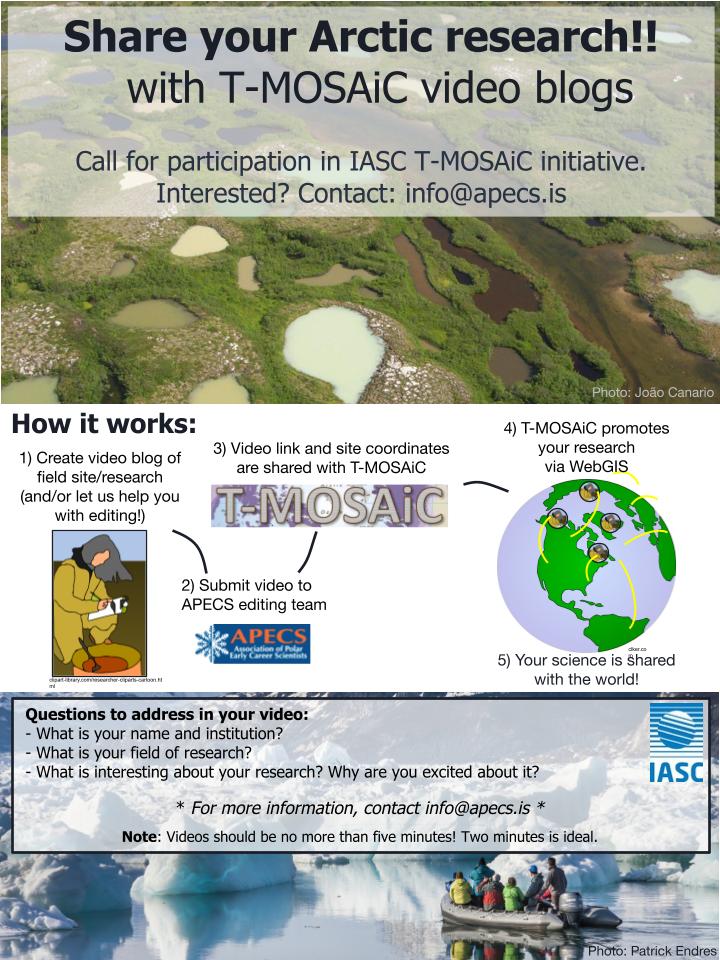 The public is increasingly aware of the Arctic and its importance to global climate and ecosystems. Yet, few people have experienced Arctic environments and the excitement scientific research in remote northern regions, despite the interconnectedness that technology offers. Our mission for the video blogs (vlogs) initiative is to help bring the public on a journey to the Arctic, to foster a deeper appreciation for northern environments and science! This initiative is developed and driven by Early Career Researchers, as part of the IASC T-MOSAiC project and APECS. A primary goal of T-MOSAiC is to connect scientific studies taking place throughout the Arctic and across disciplines in order to generate new insights into northern geosystems, ecosystems and human systems. The project was started collaborating with IASC through T-MOSAiC initiative to increase the awareness of Arctic ecosystems. Considering the APECS focus, which includes both Polar regions, as well as Alpine and Cryosphere, the project area extended to not only Polar regions, but also Alpine and Cryosphere-related places. Therefore, we highly encourage participants to share their works to help us inspire the general public with your valuable research!"
If you are interested in sharing your work, please participate via this form. For any questions, please email This email address is being protected from spambots. You need JavaScript enabled to view it..
Watch out the APECS T-MOSAIC Video Blog on Vimeo.
View the T-MOSAiC Field Vlogs Map.
0
Outreach

© Ricardo Matias, Jukes Liu, Linde van Bets, Henrik Christiansen, Quentin Jossart (left to right)
An important part of our job as scientists is communicating our research and its importance to others. This communication happens on many levels. We have well established methods of sharing our research with others in our field and with the broader scientific community through our publications, conference presentations, posters, etc. Our ways of communicating with the general public, decision makers, teachers and students are less formalised and often less practised, but this communication is essential for the greater impact of our research.
The IPY placed a strong emphasis on education and outreach in its planning and many early career polar researchers are using this momentum to get involved in broader communication of their work and the importance of the Polar Regions. Here you can find out about polar science outreach activities and how to get involved, share experiences of outreach involvemnet, and find tips and resources for communicating research.
0
Polar Outreach Resources

© Ricardo Matias, Jukes Liu, Linde van Bets, Henrik Christiansen, Quentin Jossart (left to right)
1
Polar Resource Book
© Ricardo Matias, Jukes Liu, Linde van Bets, Henrik Christiansen, Quentin Jossart (left to right)
 The Polar Resource Book - Polar Science and Global Climate: An International Resource for Education and Outreach - was published in 2010 and created to ensure efforts catalyzed by the International Polar Year (IPY) will continue to inspire educators, students, and emerging polar researchers into the next generation of young, international, polar researchers with a shared commitment to outreach and education.
Polar Science and Global Climate: An International Resource for Education and Outreach comprises background information on recent polar research and the history of IPY. It addresses climate change related issues from the perspective of the indigenous population in the Arctic. It provides a selection of teaching resources on six polar themes (atmosphere, ice, ocean, land, people and space) and showcases large- and small-scale education and outreach projects successfully carried out during the IPY.
The project has received support from a wide range of actors who are part of the IPY community, the World Meteorological Organization (WMO), the International Science Council (ICSU), as well as the Canadian IPY Secretariat and IPY Program, the National Academies of the United States, the United National Environment Program (UNEP) and the organising committee for the flagship IPY Oslo Science Conference (OSC), and the Association of Polar Early Career Scientists (APECS).
General Editor: Bettina Kaiser
Associate Editors: Becky Allen and Sandra Zicus
2010 Published by Pearson Education Limited
0
Blogs
One of the easiest ways to share your research with friends, family and others is to use a blog. These can be daily details on what you are working on in the field or in the lab, or once-a-week updates. Here we share with you some of the blogs from APECS members and other polar organizations.
© Ricardo Matias, Jukes Liu, Linde van Bets, Henrik Christiansen, Quentin Jossart (left to right)
20
Polar Outreach Blog
The APECS Education and Outreach Committee started up a new initiative to showcase outreach activities by scientists, researchers, research institutions and field stations in the Polar Regions and communities. We want to highlight ongoing outreach efforts as well as provide resources and examples of both successes and challenges for current outreach practitioners. If you have an outreach story you'd like to have featured or know of a Polar research institution or field station actively pursuing outreach, public consultation or community based research, please email your story or suggestions for a story to This email address is being protected from spambots. You need JavaScript enabled to view it.!
© Ricardo Matias, Jukes Liu, Linde van Bets, Henrik Christiansen, Quentin Jossart (left to right)
16
Polar Art Blog
© Ricardo Matias, Jukes Liu, Linde van Bets, Henrik Christiansen, Quentin Jossart (left to right)
Since September Polar Week 2019, we have been showcasing a selection of artists working across a variety of media and focusing on polar regions in their work. Through their interviews, we discussed where Polar artists draw their inspiration, which media best captures the stunning and complex landscapes of the Arctic and Antarctic, and the themes that pop up throughout their interaction with polar regions. We also discussed engagement between polar researchers and art.
8
#PolarPride Blog 2018
© Ricardo Matias, Jukes Liu, Linde van Bets, Henrik Christiansen, Quentin Jossart (left to right)
APECS was hosting the International Polar Week from 19-25 March 2018. Polar Week is a series of international events with the goal of promoting the science that takes place in polar latitudes. This March, we focused on celebrating YOU, the members of APECS through a series of fun and professional activities. What better way to celebrate our members than to recognize the work of our wonderful volunteers on the Executive Board and Council. In the blog we highlighted the accomplishments of some of our outstanding leaders and members!
5
Where Your Goose Takes You - 2014
© Ricardo Matias, Jukes Liu, Linde van Bets, Henrik Christiansen, Quentin Jossart (left to right)
 APECS and the manufacturer of extreme-weather outerwear, Canada Goose®, teamed up to highlight the work done by polar early career researchers and to keep them warm during the Where does your Goose take you? program.
A competition was organized in Spring 2014 where APECS and Canada Goose® were looking for APECS members doing field work in the Arctic or the Antarctic during 2014/15. In total APECS received 56 applicants for the 'Where does your goose take you' program. Each selected Where does your Goose take you? participant were given a Canada Goose® Expedition Jacket. The winners were:
- Lydie Lescarmontie (Australia/France)
- Marc Oliva (Portugal)
- Pierre Dutrieux (UK)
- Pamela Wong (Canada)
- Andrian Vlakhov (Russia)
- Emily Stevenson (USA)
Their task was to write two blog entries throughout the year, highlighting their polar research (science program, field sites, travel, workshops, field courses etc.).
5
Frostbytes
 APECS has teamed up with the WCRP Climate and Cryosphere (CliC) Project to share interesting information about the Polar and Alpine regions as well as the wider Cryosphere through FrostBytes – 'Soundbytes of Cool Research'. These 30-60 second audio or video recordings are designed to help researchers easily share their latest findings to a broad audience. On this page you will find information on how to create your own FrostByte as well as a few examples (find more examples here). For more information, or to add your FrostByte to our project, contact This email address is being protected from spambots. You need JavaScript enabled to view it..
© Ricardo Matias, Jukes Liu, Linde van Bets, Henrik Christiansen, Quentin Jossart (left to right)
0
MOSAiC School Outreach
 The Multidisciplinary drifting Observatory for the Study of Arctic Climate (MOSAiC) aims at a breakthrough in understanding the Arctic climate system and in its representation in global climate models. Under the umbrella of the International Arctic Science Committee (IASC), the Alfred Wegener Institute, Helmholtz Centre for Polar and Marine Research (AWI) is sending the modern German icebreaker RV Polarstern close to the north pole to get frozen in for a full year including for the first time in polar winter in 2019/2020. While drifting with the Arctic sea ice, an international team of scientists is investigating the Arctic climate processes that couple the atmosphere, ocean, sea ice, bio-geochemistry and ecosystem.
The mission is led by AWI and co-led by the University of Colorado. Support is provided by 4 additional vessels from Russia, Sweden and China which help with crew exchange, fuel supply and logistics at the end/beginning of each 6 Legs.
 Leg 1a, starting on 20 September 2019 in Tromsø, was supported by the Russian icebreaking research vessel Akademik Fedorov operated by the Arctic and Antarctic Research Institute (AARI). APECS had the unique opportunity to organize a 6-week training course for early career scientists on board Akademik Fedorov: The MOSAiC School 2019.
Learn more about the MOSAiC School and the outcome of the School, the MOSAiC Ambassador’s projects!
Here we would like to feature MOSAiC Ambassador Anika Video on the MOSAiC Expedition - enjoy!
MOSAiC Expedition Video by Anika Happe from APECS Webinars on Vimeo.
7
MOSAiC School 2019
The MOSAiC School 2019 was a 6-week training course organized by the Association of Polar Early Career Scientists (APECS) and the Alfred-Wegener Institute, Helmholtz Centre for Polar and Marine Research (AWI), with support from the Arctic Research Icebreaker Consortium (ARICE), the International Arctic Science Committee (IASC), as well as the Year of Polar Prediction (YOPP) and the Climate and Cryosphere (CliC) Project of the World Climate Research Programme (WCRP). The school was organized from 16 September to 28 October 2019 as part of the Multidisciplinary drifting Observatory for the Study of Arctic Climate (MOSAiC) expedition on the Russian icebreaking research vessel Akademik Fedorov operated by the Arctic and Antarctic Research Institute (AARI).

For questions please contact This email address is being protected from spambots. You need JavaScript enabled to view it..
20
MOSAiC Ambassadors' Projects
 Twenty highly enthusiastic, and through the MOSAiC School 2019 well trained early career polar researchers will engage with public outreach and science communication during the full year of the MOSAiC project. Please see their projects here!
You can follow their activities along on a special MOSAiC Ambassadors’ Journal twitter channel moderated by MOSAiC School 2019 participant Marylou Athanase.
MOSAiC School 2019 (Photo credits to Dave Costa, CIRES)
46
MOSAiC Ambassador's Blog: Rosalie McKay
Ever wonder what happens behind the scenes on an Arctic expedition? I wondered this as I prepared for the 2019 MOSAiC school. What to bring, what I would miss, how would I find the crowded conditions on the ship? An expedition with the size and scope of MOSAiC requires many years of planning, and will yield many years’ worth of data. All of this work aside, how do scientists pass the time? What do our instruments look like? And most importantly, how do you survive for weeks without internet??? Read along to find out more behind the snapshots of the MOSAiC school in 52 seconds.
0
Outreach Events
© Ricardo Matias, Jukes Liu, Linde van Bets, Henrik Christiansen, Quentin Jossart (left to right)
0
Hidden Menu
0
Events Archive
APECS aims to provide opportunities for young researchers to connect with senior researchers and leaders in the international polar science community. Aside from our online activities, we also plan events, such as career development workshops and mentor panels in connection with larger scientific conferences where polar researchers will be present. This maximizes the number of mentors that can participate and at the same time minimizes the need for additional travel support for early career researchers to attend these events. Conference organizers often provide the use oft he conference venues as an in-kind support. Besides providing practical career development skills which early career researchers need for a successful career in polar science, these events also help early career researchers to "break the ice" and help generate communication between the next generation of researchers and those experienced scientists that know the field through years of research experience.
In the last few years, many APECS events around the world were organized by many of our members on a voluntary basis. APECS wants to especially thank all those that were involved in organizing these and spent many hours of their free time in making these a success. Without your help and tireless effort these would not be possible! A special thank you also to all the sponsors that provided funding support for some of these events.
© Deniz Vural, Jilda Caccavo, MariamaDryak, Cynthia Sassenroth, Matias Ricardo (left to right)
0
Events 2021
APECS and its National Committees and Project Groups organized several events during 2021, either as stand-alone events or attached to various international science conferences around the world. The links to some of the highlights you can find below.
3
APECS/YESS/YOPP Workshop at ASSW2021
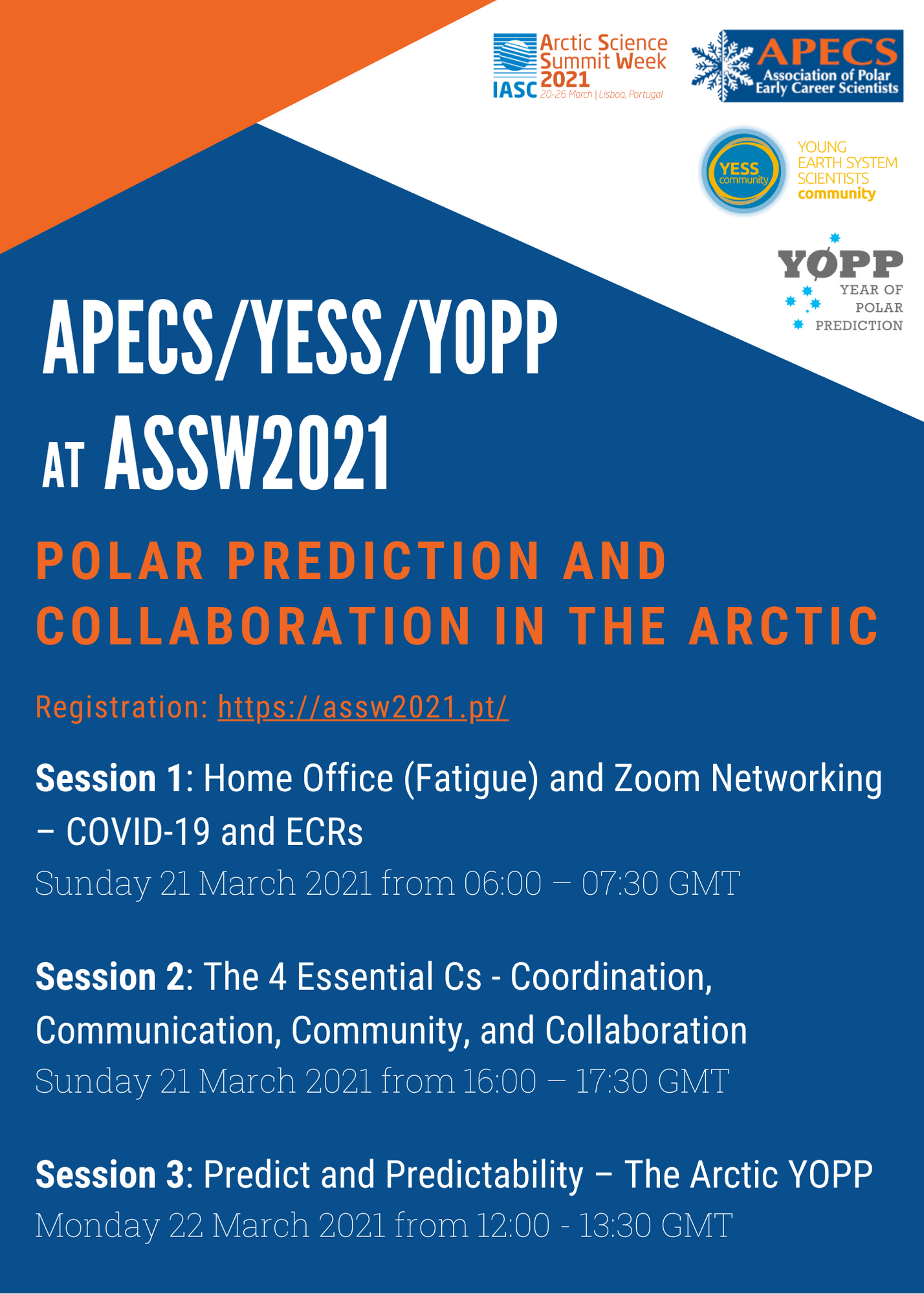
The Association for Polar Early Career Scientists (APECS) organized together with the Polar Prediction Project’s (PPP) International Coordination Office and the Young Earth System Science (YESS) network a workshop during the business meetings of the Arctic Science Summit Week 2021, organized virtually by Portugal.
The workshop was split into three 1.5h sessions over two days (21 and 22 March 2021).
- Session 1: “Home Office (Fatigue) and Zoom Networking – COVID-19 and ECRs” Sunday, 21 March 2021 06:00 – 07:30 GMT
- Session 2: “The 4 Essential Cs - Coordination, Communication, Community, and Collaboration” Sunday 21 March 2021 16:00 – 17:30 GMT
- Session 3: “Predict and Predictability – The Arctic YOPP” The Year of Polar Prediction (YOPP) Monday 22 March 2021 12:00 – 13:30 GMT
9
APECS International Online Conference 2021
 © created by Carla Tapia Baldis /Freepik
The Association of Polar Early Career Scientists (APECS) organized the 7th annual APECS International Online Conference which took place on Wednesday, 12th May 2021. This year’s theme “Polar Science: Success Stories from the Field and from Home” aimed to involve polar and alpine researchers from around the world.
The theme was designed to encourage contributions from those whose research has been impacted by Covid-19 and had to develop new directions with their research. It also acknowledged that some were able to carry out fieldwork, and so also gives a space for them to showcase their research. The conference was an opportunity for new research to be presented and connections to be made across polar research. After what has been a difficult year for everyone around the world, we wanted to celebrate and learn from your stories related to the polar and alpine regions that happened in 2020. We heard both success stories and stories of learning from failure. The ultimate goal of the project wass to unite the ECR community in a collegial and learning experience organized under the 7th annual APECS Online Conference.
0
Events 2020
APECS and its National Committees organized several events during 2020, either as stand-alone events or attached to various international science conferences around the world. The links to some of the highlights you can find below.
8
APECS International Online Conference 2020
© created by Kate Chenier and Hugo Guímaro
 The Association of Polar Early Career Scientists (APECS) organized the 6th annual APECS International Online Conference live on 20 May 2020. This year’s theme was, "Opening Doors: Collaboration across knowledge systems" aiming to encourage collaboration between early career researchers, science communicators, educators, and local community members in polar and alpine regions.
The 6th edition of the APECS International Online Conference focused on knowledge exchange among multidisciplinary scientists, local communities, educators and science communicators. In a fast changing world, we believed it is important to pair traditional knowledge, education, and outreach with science efforts to better understand present and future challenges to the polar regions. This sort of comprehensive approach was best achieved by incorporating knowledge from a diverse array of disciplines and perspectives and is especially important for guiding policy-making. Through this conference, we hoped to gain a better understanding of the many ways that Indigenous knowledge, science communication, and art can benefit our research. With this, APECS called for early career researchers, science communicators and educators to come forward with a short presentation outlining their approach for promoting collaboration in polar science. This year’s conference was also introduced online breakout chat rooms through the Zoom platform, to foster interactions between presenters and attendees and to enable future collaboration. Within our team, we had science communication experts that assisted as facilitators in these chats.
Event Date: 20 May 2020
4
SCAR 2020 Workshop “Antarctic Science - Global Connections”
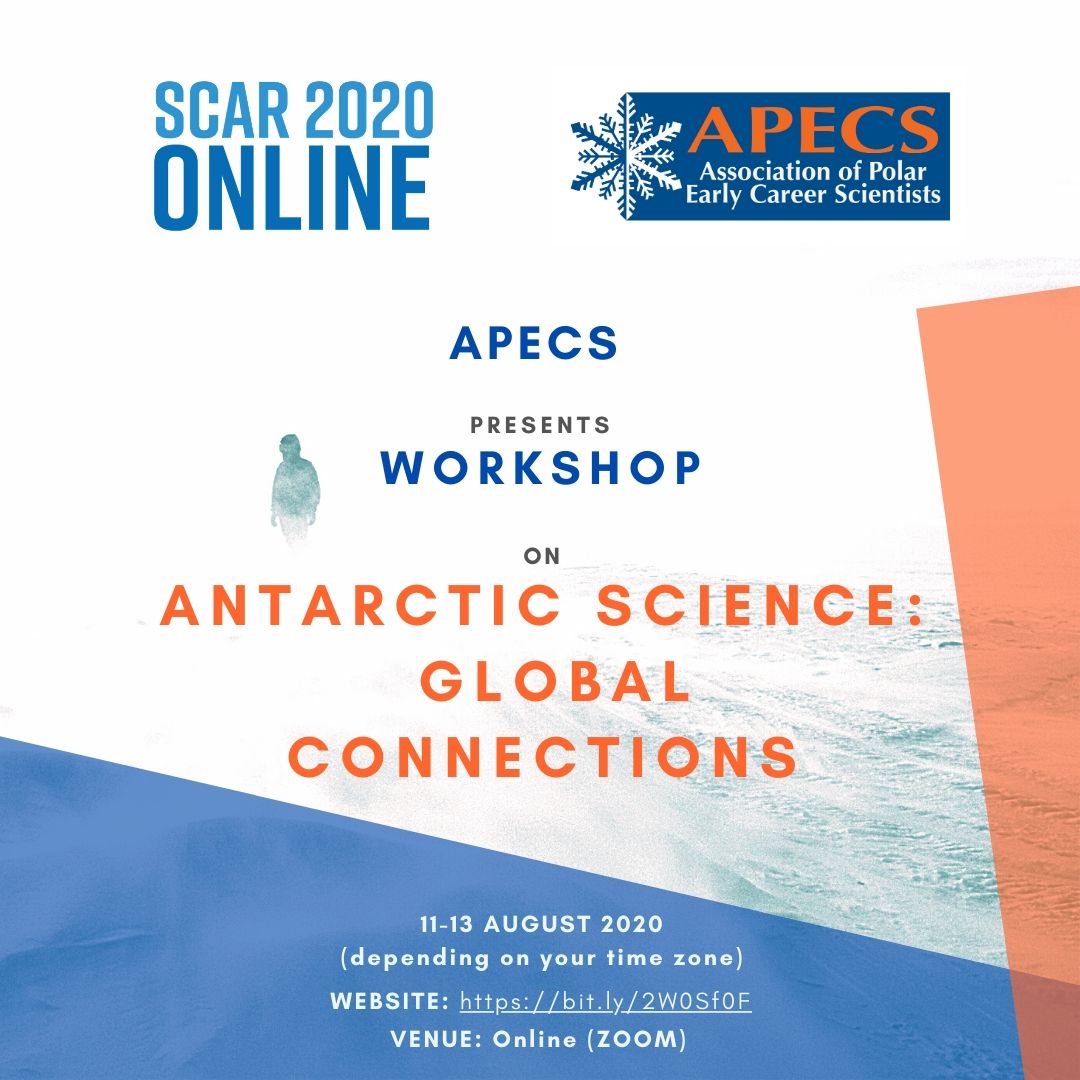 The Association of Polar Early Career Scientists (APECS) organized an early career workshop in collaboration with the Scientific Committee for Antarctic Research (SCAR), entirely online. The theme for the workshop was “Antarctic Science - Global Connections”, aiming to bring together polar ECRs from around the globe to network, engage with topics presented at the workshop through a series of plenary and workshop sessions, and to potentially develop new research ideas and collaborations to take forward into their careers in the future.
Event date: 11-13th August, 2020
Location: Online!
Topic overview:
August 11th: Introduction and Plenary
August 11th: Science Communication: what can we learn from journalists and outreach projects that have succeeded
August 11th: The Year of Polar Prediction (YOPP)
August 12th and 13th: Logistical Collaboration
Download the workshop program here.
0
Events 2019
APECS and its National Committees organized several events during 2019, either as stand-alone events or attached to various international science conferences around the world. The links to some of the highlights you can find below.
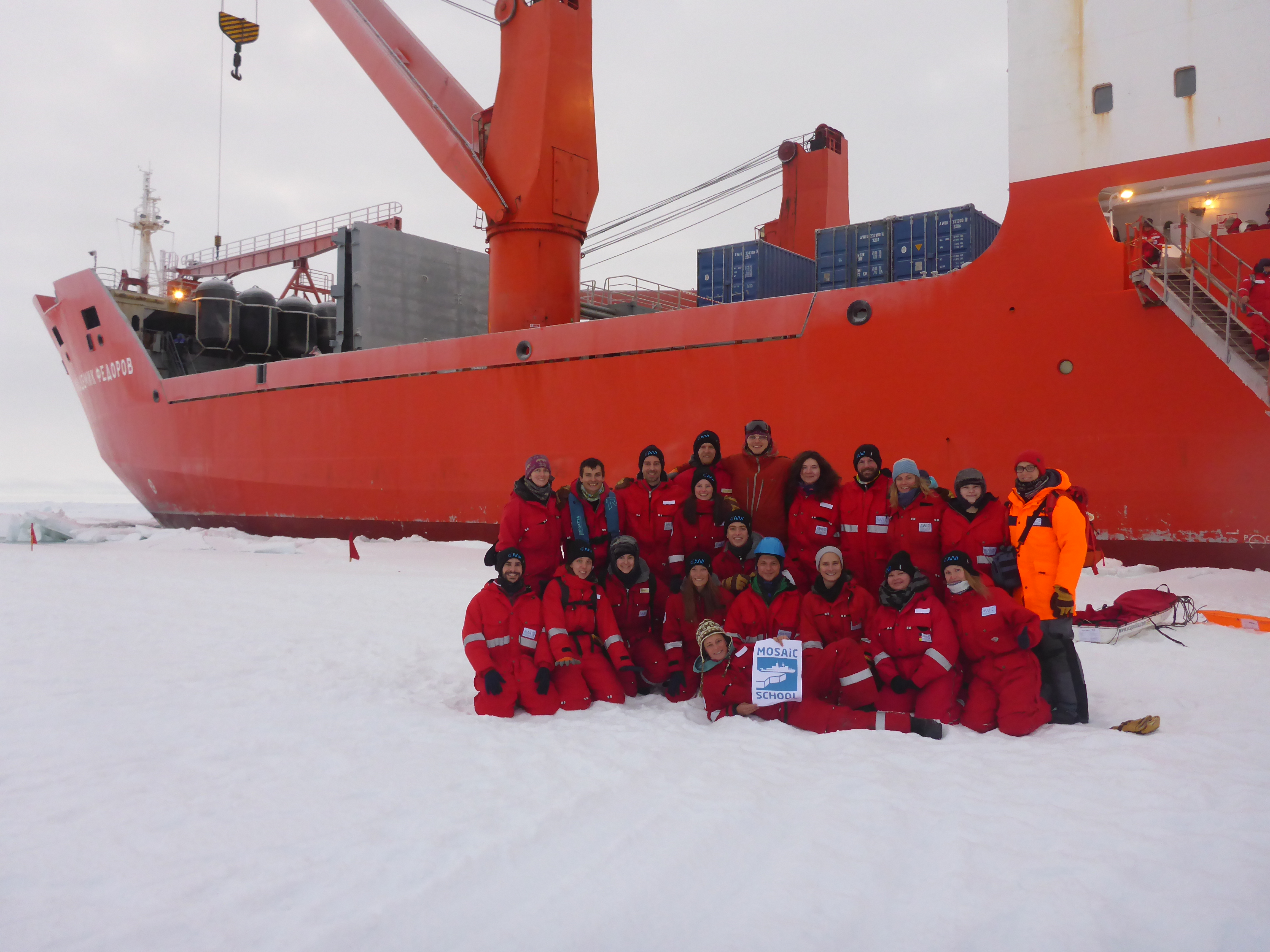
Photo: Participants of the MOSAiC School 2019.
6
APECS Online Conference 2019
 APECS International Online Conference 2019, “Breaking Barriers: Promoting Interdisciplinarity in Polar Science”
Event Date: 20 May 2019
The Association of Polar Early Career Scientists (APECS) organized its 5th annual APECS International Online Conference on 20 May 2019. This year’s theme, “Breaking Barriers: Promoting Interdisciplinarity in Polar Science” aimed to encourage collaboration between early career scientists from varied disciplines, working in the polar and alpine regions.
Science is about understanding the nature and mechanism of the world. But, understanding the mechanisms related to the “three poles” requires an integrated approach. Interdisciplinarity was one of the main discussion topics during the 2nd APECS World Summit, and it was clear that to achieve big results several tools from different disciplines must be incorporated. One example is climate change; to truly understand climate change and its impacts, we need to bring together the relevant disciplines of climate, environment, social sciences, and others under a multidisciplinary ceiling and assess various ways to understand its complex and interrelated causes and effects. No single approach will work for all. Climate change is not the only topic that can benefit from the integration of cross-disciplinary expertise; understanding how polar oceans function, how continents and alpine regions form, contamination pathways, and many other questions related to the three poles calls for interdisciplinarity. With that intent, APECS calls for ECRs to come forward with their interdisciplinary take on an otherwise contemporary science, by presenting their approach to developing research goals, methods, and outcomes as a short presentation in our one-day Online Conference.
The detailed conference programme including all abstracts can be found below:
2
ASSW 2019
APECS Workshop "Socio-ecological Interactions in the Arctic for Integral Sustainability" at Arctic Science Summit Week (ASSW) 2019
 Date: 23 May 2019
Location: Arkhangelsk, Russia
The Arctic in its geographical holistic context is the basis for the coherent existence of socio-ecological systems. Being both the populated region and environment for many vulnerable species, the Arctic calls for the complex and integral research in order to reach sustainable development goals. The topic of APECS Workshop at the Arctic Science Summit Week 2019 was thus “Socio-ecological interactions in the Arctic for Integral Sustainability”. The programme included both scientific and career development parts which were outlined in a unique format. During the workshop, we aimed to look into the Arctic socio-ecological interactions as a complex system which facilitates and forces interdisciplinary research and the convergence of social and natural sciences in order to aim sustainable development goals for Arctic agenda. The career development part was structured within the scientific and practical (work within break-out groups) parts to frame the understanding of Arctic research planning. At the end of the APECS Workshop day, we worked on general Statement including young scientists’ voices and was passed on to the IASC for future Arctic research planning and community input to the Arctic Council’s Agreement on Enhancing International Arctic Scientific Cooperation.
© Photo created via canva.com by Yulia Zaika
3
Science Policy Workshop 2019

The Workshop "Raising awareness and building capacity for science-based policy-making" took place on 8 - 9 October 2019 in Reykjavik, Iceland and was organized by the Association of Polar Early Career Scientists (APECS), the German Arctic Office of the Alfred Wegener Institute, Helmholtz Centre for Polar and Marine Research (AWI), and the Icelandic Center for Research (RANNIS), in cooperation with the German Embassy in Reykjavik and supported by the German Federal Foreign Office and the United Kingdom Foreign and Commonwealth Office.
The dialogue between scientists and policy-makers is crucial to ensure that climate and environmental policies are based on sound scientific knowledge. Therefore, the knowledge transfer from science to policy plays a major role in modern science and will be even more important in the future. Exposing researchers to the science-policy-interface is particularly important in an early career stage to develop an understanding of the tools and processes involved and a natural collaboration beyond science. Policy needs scientists who have consolidated knowledge and give objective and independent advice.
Communicating scientific information to policy-makers requires certain skills in translating the scientific information into information that can be understood by policy makers or non-scientists, as scientists and policy-makers very often speak different “languages”. This workshop aimed thus to provide training to early career researchers to raise awareness of the need to communicate beyond the research community, to introduce new career paths for early career researchers outside academia and to lower “mental barriers” in the transition between politics and science.
The agenda included invited introductory keynote presentations by both policy-makers and scientists experienced in knowledge transfer. Two breakout groups led by invited mentors discussed specific elements of the science-policy-interface in more detail.
The two-day workshop gathered 30 Arctic research-focused PhD students and PostDocs from both natural and social sciences and early career Arctic indigenous researchers and knowledge holders.
5
APECS-APPLICATE-YOPP Online Course 2019
 The Association of Polar Early Career Scientists (APECS), in collaboration with the APPLICATE (Advanced Prediction in Polar regions and beyond: modelling, observing system design and LInkages associated with a Changing Arctic climaTE) project and the Year of Polar Prediction (YOPP) organised a free online course on "Advancing Predictive Capability of Northern Hemisphere Weather and Climate” that took place from September to December 2019.
About the partners: APPLICATE is one of the projects within the EU Arctic Cluster, a network of projects funded through the EU Horizon 2020 and Framework Programme 7. The scope of APPLICATE is to improve weather and climate predictions in the Arctic. Studying the influence of Arctic climate change on Northern Hemisphere mid-latitudes, APPLICATE fosters engagement with policy makers, industry and other stakeholder groups who benefit from improved predictive capacity in Arctic regions. The Year of Polar Prediction (YOPP) is the flagship activity of the World Meteorological Organization (WMO)' s Polar Prediction Project with the aim of enabling a significant improvement in environmental prediction capabilities for the polar regions and beyond, by coordinating a period of intensive observing, modelling, verification, user-engagement and education activities. APPLICATE is one of the key projects endorsed by the Year of Polar Prediction.
About the course: The course was a training activity within the APPLICATE project (Work Package 7: User engagement, dissemination and training) and the Year of Polar Prediction education effort. An introduction to APPLICATE`s research focus and goals can be found in these three webinars. The online course was designed for early career researchers (e.g., Master and PhD students, Postdocs) with a specific interest in Arctic weather and climate prediction and modelling.
This course provided an overview of the state-of-the-art knowledge of Northern high-latitude weather and climate predictions; including aspects relevant for the Arctic climate system; and linkages between Arctic and mid-latitude/global weather. The topics included an overview of the observing system design in the Arctic, current methods in weather and climate predictions and how predictive skill can be improved. An important aspect of the course were Arctic extreme weather phenomena and engagement of stakeholders who are using weather and climate predictions in their daily operations.
This course was supported through the APPLICATE project that received funding from the European Union’s Horizon 2020 research and innovation programme under grant agreement No 727862, the Year of Polar Prediction, the Association of Polar Early Career Scientists (APECS), the Alfred Wegener Institute, Helmholtz Center for Polar and Marine Research, and UiT The Arctic University in Tromsø.
© Photos by Fiona Tummon and Gerlis Fugmann from the Polar Prediction School 2018
4
Conferencia Iberoamericana Online
English Summary: The Conferencia Iberoamericana Online aimed to create a space where Polar Early Careers Researchers and Educators from Spanish-speaking countries could share their work in their native language among peers and interested public. This event was an opportunity for multidisciplinary learning and international networking breaking the barriers of language, bringing together enthusiastic people with an interest in the Polar Region and Cryosphere. The Conferencia Iberoamericana Online was held on Thursday 26 September, 2019 at 19:00 GMT. See more information about the conference below (in Spanish). For enquiries, please contact This email address is being protected from spambots. You need JavaScript enabled to view it..

© globe designed by Pablo Ruiz Teneb
0
Events 2018
APECS and its National Committees organized several events during 2018, either as stand-alone events or attached to various international science conferences around the world. The links to some of the highlights you can find below.
Photo: APECS Council Members at the APECS World Summit 2018.
3
Arctic Frontiers 2018
APECS was once again partner of the Arctic Frontiers 2018 conference that took place in Tromsø, Norway, from 22-26 January 2018. This year’s theme was connecting the Arctic and APECS contributed to the Arctic Frontiers Young programme with several activities:
- An “Adventures in the Field” panel discussion on 23 January
- Arctic Frontiers “Science for Schools” from 23-25 January
- Early Career Nansen Poster Awards on 24 January
6
Polar Prediction School 2018
 The EU Horizon 2020-funded APPLICATE project, in cooperation with the World Meteorological Organization’s Polar Prediction Project (PPP) in occasion of the Year of Polar Prediction (YOPP), the Association of Polar Early Career Scientists (APECS) and other partners organized the Polar Prediction School 2018 on weather and climate prediction in the polar regions from 17 - 27 April 2018 at Abisko Scientific Research Station in Sweden.
The course covered topics including chaotic systems and predictability, polar boundary layer processes, polar clouds, sea ice and high latitude ocean processes, polar extreme weather and polar-mid-latitude linkages. It included a combination of polar weather and climate theory lectures with exercises on modelling and field meteorology techniques as well as soft skill training. Each of these components forms a crucial pillar of the prediction problem, and the motivation for combining these is to provide participants with a complete overview of the components required to understand and predict polar weather.
The Polar Prediction School 2018 was open for 30 early career researchers (focus on advanced graduate students, PhD students and postdoctoral researchers) from around the world. An international group of instructors taught the sessions and the course was run at the Abisko Scientific Research Station in Sweden, where instructional facilities are conveniently located in an environment well suited to Arctic observations. Here participants begun to develop a sense for the environment they are studying.

2
Nunataryuk Workshop 2018
 APECS, in cooperation with the EU Horizon 2020-funded project Nunataryuk, organized the Nunataryuk Workshop 2018 for early career researchers participating in the Nunataryuk project. The workshop took place in connection with the first General Assembly of Nunataryuk from 30 September - 6 October 2018 on the island of San Servolo near Venice, Italy.
0
POLAR 2018
 POLAR 2018 was a joint conference organized by the International Arctic Science Committee (IASC) and the Scientific Committee on Antarctic Research (SCAR) held in Davos, Switzerland from 15-26 June 2018.
It included the following meetings:
- XXXV SCAR Biennial Meeting
- Arctic Science Summit Week 2018 & IASC Business Meetings
- SCAR/IASC Open Science Conference
- 2018 Arctic Observing Summit
- 2nd APECS World Summit
APECS organized several activities during the conference among others the poster awards and the APECS World Summit 2018. We also to distribute travel awards provided by several organizations to participants of the conference. Read about some of the highlights below.
4
APECS World Summit 2018
 The Association for Polar Early Career Scientists (APECS) organized its 2nd APECS World Summit 2018 "Connecting the Poles" directly before POLAR2018 - the joint SCAR and IASC Conference - in Davos, Switzerland on 17-18 June 2018.
Day one (Sunday, 17 June) of the APECS World Summit 2018 brought together official representatives from the APECS National Committees and APECS’ leadership to discuss APECS projects and the current and future state of collaborative research between polar regions. Day two (Monday, 18 June) was an open workshop for all interested early career researchers attending POLAR2018, focusing on interdisciplinary research, collaboration and exchange. Check out our preliminary schedule for both days below.
You can learn more about APECS’ 1st World Summit in 2015, themed "The Future of Polar Research," on our website. At this event in Sofia, Bulgaria, we were thrilled to host 66 early career scientists and APECS members representing 25 countries and 20 National Committees. We expect our 2nd World Summit to be even bigger and better!
1
Travel Awards
APECS helped coordinate travel awards provided by several organizations for the POLAR2018 conference.
1
Poster Awards
APECS, SCAR and IASC organized an Early Career Research Poster Award for POLAR2018.
6
APECS Online Conference 2018
The Association of Polar Early Career Scientists (APECS) organized the 4th annual APECS International Online Conference on 16 May 2018. The theme, “Butterfly Effect: Small Changes, Big Impact,” challenged polar scientists to communicate the impacts of changes occurring in and connected to polar and alpine regions, including their environment, local communities, science methods, and policy and education.
Conference Date: 16 May 2018
The Poles are dynamic and complex regions, vulnerable to the effects of climatic and other changes, and inextricably linked to the rest of the globe. The concept of the butterfly effect was originally coined by Edward Lorenz to illustrate how a tornado could be affected by minor changes, such as the flapping of butterfly wings far away and several weeks earlier. This concept also has broader applications. For example, a change in the mid-latitudes can effect changes at the Poles and vice-versa; minute temperature changes can significantly impact local communities or ecosystems; the development of new scientific methods and technologies can generate answers to outstanding questions and open new fields of research; in the wake of shifting global politics, a small alteration to a document can modify treaty impacts and lead to significant consequences; a small act in your community, such as sharing your science at a local school, can inspire and mold future visions for our planet.This year, APECS challenged the scientific community to make an impact by presenting the large and the small of their research ideas, methods, and outcomes: a short presentation in our one-day virtual event can have a significant impact, both on you and the audience of the 4th APECS International Online Conference!
The detailed conference programme including all abstracts can be found below:
2
APECS-UArctic Workshop 2018
 The Association of Polar Early Career Scientists (APECS) and the University of the Arctic organized a science communication workshop in connection with the UArctic Congress 2018 in Oulu, Finland on 3 September 2018.
0
Events 2017
APECS and its National Committees organized several events during 2017, either as stand-alone events or attached to various international science conferences around the world. The links to some of the highlights you can find below.
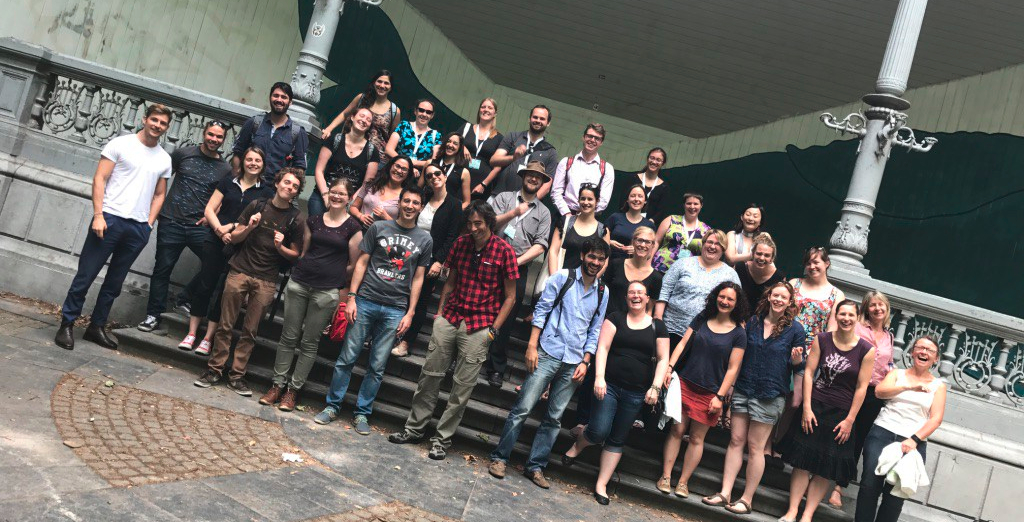
Photo: Participants of the APECS workshop at the SCAR Biology Symposium 2017.
4
ASSW 2017
The Association of Polar Early Career Scientists (APECS) organized a career development workshop at the Arctic Science Summit Week 2017 in Prague, Czech Republic on 2 April 2017.
2
ICASS IX 2017
The Association of Polar Early Career Scientists (APECS) organized a career development workshop at the 9th International Congress of Arctic Social Sciences (ICASS IX): People and Places in Umeå, Sweden on 7 June 2017.
7
APECS Online Conference 2017
 APECS organized the third APECS International Online Conference 2017 on the 20th of March 2017. This year’s theme was: “Outside the Box: encouraging alternative solutions for undertaking and communicating polar research.” As a new generation of polar researchers stepping up to the plate, we must embrace new and innovative polar challenges. Our ability to successfully address such challenges and steer the polar world in a positive direction has far-reaching local, regional, and global consequences.
The conference attracted more people than ever before, with over 40 presenters and 100 audience members registered. We heard a full and successful day of presentations about Outside the Box polar research. The presenters covered a wide range of topics ranging from social to physical to life sciences, as well as educational and managerial talks.
Thank you to all presenters and audience members for making the day a huge success! More of us are now thinking Outside the Box to address polar challenges facing our generation. Special thanks to Jane Francis - Director of the British Antarctic Survey, and John Walsh - Chief Scientist at the International Arctic Research Center (IARC), for their inspiring keynote presentations that were very well received!
Prizes were awarded to:
- Maciej Mańko, Katarzyna Walczyńska received ₠200 for the best Arctic presentation titled: 'On-board Citizen Science! How Tourist Can Aid Marine Biodiversity Monitoring in Svalbard?' (session 1)
- Hernan Sala received ₠200 for the best Antarctic presentation titled:'Why is it Hard to Communicate the Future of the Antarctic Ice Sheet?' (session 4)
- Nuno Pereira received ₠200 for the most “Outside the Box” presentation titled: 'ViRAL: Virtual Reality Antarctica Laboratory' (session 2)
Congratulations to our award winners! Thank you to our sponsors - the Association of Polar Early Career Scientists (APECS) and Antarctic Science Ltd, for funding the awards. We are also greateful to all the presenters and volunteers who made the conference possible.
We should not be afraid to venture Outside the Box of the ideas that previous generations of polar researchers have left us in order to overcome the severity of polar challenges we face. Striving to succeed, we must discover new ways of thinking and acting, using to our advantage: international and interagency collaborations; idea-sharing between poles; interdisciplinary and transdisciplinary approaches to research; technology and our ability to modify and develop it to suit our needs; affordable methods of research; improved ways of communicating scientific and social research; and most importantly ideas we haven’t thought of yet but you have! To this end, APECS wishes to foster the sharing of alternative solutions for undertaking and communicating polar research, allowing a new generation of polar researchers to shine.
All sessions were recorded, and are available via the APECS vimeo channel:
Session 1 (07:30 - 09:50 GMT): Session 1 Recording Link
Session 2 (10:45 - 12:15 GMT): Session 2 Recording Link
Session 3 (13:30 - 15:45 GMT): Session 3 Recording Link
Session 4 (16:45 - 19:00 GMT): Session 4 Recording Link
Session 5 (19:45 - 21:45 GMT): Session 5 Recording Link
Session 6 (22:30 - 00:30 GMT): Session 6 Recording Link
The detailed conference programme, including all abstracts, can be found below.
4
SCAR Biology 2017
 The Association of Polar Early Career Scientists (APECS) organized a career development workshop at The Scientific Committee on Antarctic Research Biology Symposium
Location: KU Leuven, Kolenmuseum, room KOL 0.04, Charles Deberiotstraat 32, B-3000 Leuven, Belgium
Date: 9 July 2017
3
AMAP 2017
 The Association of Polar Early Career Scientists (APECS), the International Arctic Science Committee (IASC) and the Arctic Monitoring and Assessment Programme (AMAP) organized a workshop on “Scientific Assessments: Process, Dissemination and Impact” at the International Conference on Arctic Science: Bringing Knowledge to Action in Reston, Virginia, United States.
Workshop Date: 24 April 2017
Workshop time: 09:00 – 17:00
Location: Lake Fairfax B Room
There is an urgent, recognized need to bridge the gap between science and policy/decision-makers/Arctic communities to enhance the use of scientific knowledge as a basis for decision-making. Assessments document and provide the critical knowledge on changes in the Arctic region and contribute to international processes and negotiations on climate change, pollutants, development, biodiversity, and more. Scientific assessments are principal mechanisms for harnessing scientific information to inform policy- and decision-making.
A scientific assessment is, however, far more than just a final report or deliverable, it is the entire multi-year process, within which expert knowledge is gathered, evaluated, interpreted - before it is communicated to decision-makers and other audiences.
Participants learned more about scientific assessments, their do’s and don’ts, best practices in translating and communicating science and knowledge into action, and how individual scientists can make their voice heard. Workshop outcomes contributed to the discussions on the last day of the conference.
Workshop Organizing Team: Gosia Smieszek (Arctic Centre, University of Lapland/ IASC), Gerlis Fugmann (APECS / AWI, Germany), Allen Pope (IASC, Iceland), Kristin Timm (George Mason University, United States), Yulia Zaika (Khibiny educational and scientific base of the Faculty of Geography M.V.Lomonosov Moscow State University, Russia)
0
Events 2016
APECS and its National Committees organized several events during 2016, either as stand-alone events or attached to various international science conferences around the world. The links to some of the highlights you can find below.
Photo: Participants of the APECS workshop at the SCAR Open Science Conference 2016.
4
Arctic Frontiers 2016
APECS was again a partner of the Arctic Frontiers 2016 conference in Tromsø, Norway from 24 – 29 January 2016 with the theme "Industry and Environment" and contributed to the Arctic Frontiers Young with a number of activities:
- Science Communication Panel on 26 January
- Arctic Frontiers "Science for Schools" (26 / 28 January)
- Arctic Frontiers "Science for Politics" (27 January)
- Arctic Frontiers Early Career Poster Awards (28 January)
2
ASSW 2016
APECS organized several events at the Arctic Summit Science Week (ASSW) 2016 in Fairbanks, Alaska (12 - 18 March 2016)
- a half-day Early Career Arctic Policy Workshop on Monday, March 14 from 9:00 - 12:30 addressing the global effort to use best-available science in the development of Arctic policy.
- an in-person meeting of the APECS Executive Committee 2015-2016 on 10 - 11 March
6
APECS Online Conference 2016
APECS International Online Conference: Polar Science: Through New Eyes
Conference Date: 18 May 2016 (08:50 GMT to 21:20 GMT)
Event Format: Online conference (webinar)
This conference engaged scientific dialogues between early career scientists from multiple disciplines and backgrounds on new research perspectives in their field of research. With increased attention on the changing polar environment and the future challenges this will bring, this conference aimed to convey the broad range of new research currently being conducted internationally. Sessions covered a range of disciplines, including Oceanography, Biology, History, Policy, Education, Geology, Atmosphere, and Climate Research, and audience engagement was encouraged.
Conference Organizing Committee: Lorna Thurston, Rachel Downey and Hanne Nielsen
2
SCAR OSC 2016
APECS organized several activities during the SCAR Open Science Conference 2016 in Kuala Lumpur, Malaysia from 20 - 30 August 2016.
- a one-day career development workshop on 21 August 2016
- presentations awards for early career researchers
Read more about the activities below.
0
Events 2015
APECS and its National Committees organized several events during 2015, either as stand-alone events or attached to various international science conferences around the world. The links to some of the highlights you can find below.
Photo: APECS World Summit 2015 participants
4
Arctic Frontiers 2015
 APECS was again a partner of the Arctic Frontiers 2015 conference in Tromsø, Norway from 18 – 23 January 2015 with the theme "Climate and Energy" and contributed to the Young Scientist Forum with a number of activities:
- Science Communication and Media Training Workshop on 20 January
- Arctic Frontiers "Science for Schools" (20 - 22 January)
- APECS also organised the poster awards for the conference!
4
ASSW 2015
 APECS organized a workshop on "Goals of ICARP III – the future of Arctic research from the perspective of early career researchers" in Toyama, Japan in conjunction with the ASSW 2015 / ISAR-4 / ICARP III conference. The workshop took place on Sunday, 26 April 2015.
The workshop aimed to help early career researchers develop skills necessary for work and collaboration in the international and interdisciplinary area of polar research. It also aimed to identify the state of current knowledge and challenges associated with integrating Arctic systems and, most importantly, presented novel ideas for future priorities of Arctic Research beyond its regional variability and across different research fields. The workshop also looked at the results of the some of the ICARP III projects conducted by APECS, the Arctic in Rapid Transition initiative (ART) and the Permafrost Young Researchers Network (PYRN).
8
APECS World Summit 2015
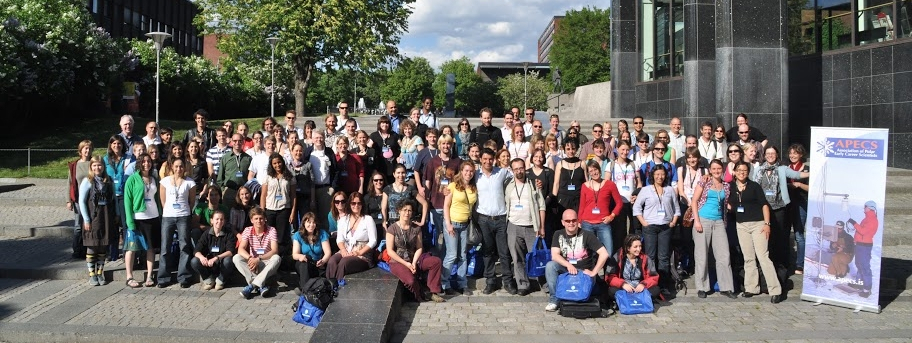 APECS organized its first APECS World Summit in Sofia, Bulgaria from 6 - 8 June 2015. Since its success during the International Polar Year (IPY), APECS has been grown significantly. At the time of the summit, APECS's membership counted about 5000 early career scientists, mentors and educators with interests in the Polar Regions in over 80 countries. But APECS has also evolved institutionally with currently 26 National Committees (NCs) across all continents – except Antarctica. The APCES World Summit 2015 "The Future of Polar Research" was an initiative to bring representatives of APECS' leadership and NCs together to discuss the future of polar research, APECS' experiences in communicating science and new challenges APECS wants to tackle in the near future. The venue for the APECS World Summit 2015 was Sofia Univeristy.
0
Events 2014
APECS and its National Committees organized several events during 2014, either as stand-alone events or attached to various international science conferences around the world. The links to some of the highlights you can find below.
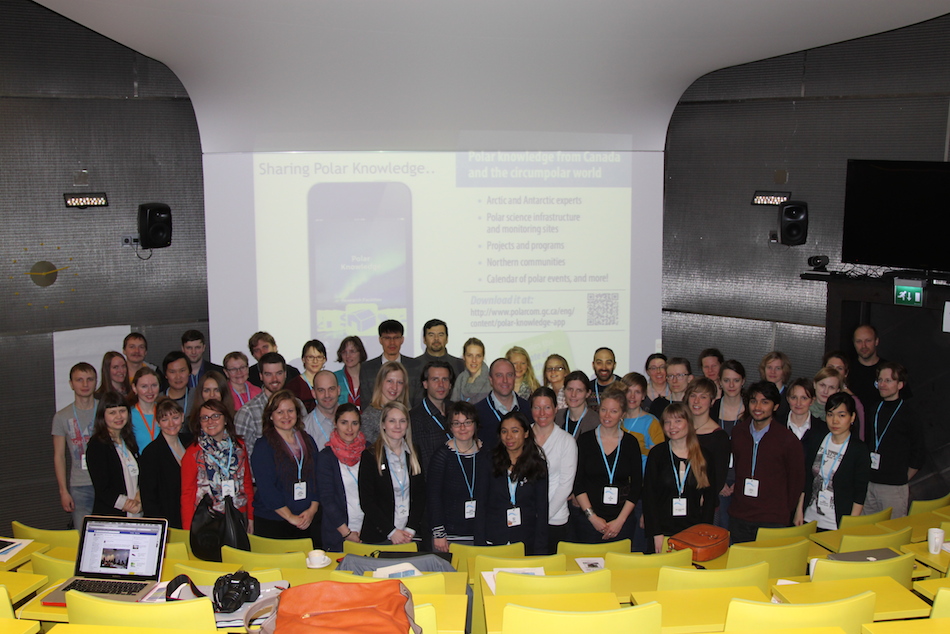
Photo: Participants of the APECS Nordic Workshop 2014 at the Arctic Science Summit Week 2014.
6
SCAR OSC 2014
 APECS organized several events during the SCAR Open Science Conference 2014 "Global Messages from Antarctica" in August 2014 in Auckland, New Zealand.
- a workshop on science communication organized by APECS and Polar Educators International (PEI) on 24 August
- an APECS Workshop on the Antarctic Environmental Portals on 28 August
- a Networking Cruise
6
Arctic Frontiers 2014
 APECS was a partner of the Arctic Frontiers 2014 conference in Tromsø, Norway from 19 – 24 January 2014 with the theme "Humans in the Arctic" and one of the main contributors to its Young Scientist Forum:
- Science Communication and Media Training Workshop on 19 January
- Networking Reception "Arctic Games" organized together with the Fram Centre in Tromsø on 21 January
- "Science For Schools" together with the Arctic Frontiers and the Science Centre of Northern Norway (Nordnorsk Vitensenteret)
- APECS also organised the poster awards for the conference for early career poster presenters
3
ICASS 2014
 APECS organized a career development workshop on 21 May 2014 during the 8th International Congress of Arctic Social Sciences (ICASS VIII) held from 22 - 26 May 2014 in Prince George, British Columbia, Canada.
About ICASS VIII: ICASS is held every three years, bringing together people from all over the world to share ideas about social science research in the Arctic. The University of Northern British Columbia was the host of the 2014 conference. ICASS VIII's theme was Northern Sustainabilities. More information can be found on the conference website: http://resweb.res.unbc.ca/icass2014/
Early Career Researcher Travel Support: The ICASS VIII Organizers and partnering organizations raised funds to provide support to students and early career scientists on a competitive basis to help cover their travel costs to attend the conference. APECS helped with the coordination of the travel awards.
10
Events 2013
3
ASSW 2013
We are still in the process of adding content to our new website. This page will be updated in the next few weeks.
2
Events 2012
5
Svalbard Workshop 2012
 Svalbard is the site for numerous international and interdisciplinary research projects every year that involve both senior and early career researchers. To foster international cooperation among all scientists, sharing of information and data on the research conducted on Svalbard is essential. Especially for early career researchers that may conduct their first field season in this area, knowing the logistics and infrastructure available to carry out their research and developing international connections with ongoing research are critical.
APECS is creating a platform for early career researchers working on Svalbard to form a network to help increase our understanding of the environment and social conditions on this Arctic Archipelago. The impetus for this network will be a workshop for early career scientists working in the various international research communities such as Hornsund, Barentsburg, Ny-Alesund and Longyearbyen, remote camps and vessels to discuss current research, develop collaborations and learn more about the facilities and research logistics offered on Svalbard.
To continue the discussion about Svalbard after the workshop and to create a site for sharing data and research projects as well as resources important for early career researchers working or wanting to work on Svalbard, APECS created this Svalbard Early Career Researcher Network Platform! We will add tools for you to share ideas and projects as well as resources like the recordings of the initial workshop, the posters of Svalbard research from the APECS Virtual Poster Session, Svalbard FrostBytes and many more!
Keep watching this page for more updates and resources! If you have any questions, want to contribute resources or have ideas about what else to include on this site, This email address is being protected from spambots. You need JavaScript enabled to view it..
0
Events 2011
4
AMAP 2011
We are still in the process of adding content to our new website. This page will be updated in the next few weeks.
0
Events 2008
3
NGPR 2008
 Participants..............Mentors..............Presentations...............Publications..............Videos......
0
Events 2023
APECS and its National Committees and Project Groups organized several events during 2023, either as stand-alone events or attached to various international science conferences around the world. The links to some of the highlights you can find below.
4
Sharing Circle for Early Career Professionals & Arctic Youth
Sharing Circle for Early Career Professionals and Arctic Youth
The Association of Polar Early Career Scientists (APECS) and the EU Project Arctic PASSION organized an APECS & Arctic PASSION Sharing Circle for early career professionals and Arctic youth! The Sharing Circle took place in Sevettijärvi and Inari, Northern Finland, from October 2-6, 2023.
Having grown up in a world of global challenges, Arctic youth and early career professionals have agency in creating positive change for the future. The Arctic will benefit from a close dialogue between Arctic youth and young professionals working in the Arctic arena. The APECS & Arctic PASSION Sharing Circle fosterd this dialogue through a week-long program in Northern Finland.
At a glance
-
 Dates: 2-6 October 2023. The program started Monday morning, 2 October 2023, and ended Friday, 6 October 2023.
- Start: Sevettijärvi, Northern Finland
- End: Inari, Northern Finland
- Language: English
- Program: Program was filled with group discussions, presentations, outdoor activities and excursions and accompanied by an online event.
- Goal: Participants gained a better understanding of the Arctic and its people, the intercultural and transdisciplinary complexity of the Arctic, and the value of sharing experiences and knowledge in collaborations. Learnings and experiences from the Sharing Circle will help participants to build a frame for working towards equitable and genuine collaborations and a sustainable Arctic future.
Participants of the Sharing Circle gained valuable insights into different cultures and the heritage of the Arctic. They discussed how intercultural and transdisciplinary cooperation can function better, and how the Arctic environment and societies are intertwined. They had the opportunity to present the challenges of their own local Arctic communities. With the Sharing Circle we provided a platform for exchange between Indigenous and local rights holders, Arctic youth, Arctic research experts and early career professionals working with Arctic topics, leading to a better understanding across the region. The connections that were made among participants, who have diverse backgrounds, experiences and perspectives, will form the basis for equitable and genuine collaborations in the future. Highlights were field visits to Indigenous-led ecological restoration sites, such as rivers and lake restoration.
After the Sharing Circle, participants are now serving as Arctic PASSION Ambassadors for one year and will develop their own outreach project to pass on their learnings to their communities, institutes or other chosen audiences.
By attending the Sharing Circle, participants:
-
- gained new perspectives on Arctic issues and Arctic collaborations.
- were empowered to establish meaningful collaborations across sectors and cultures.
- got a better understanding about life in the Arctic and the intercultural and transdisciplinary complexity of the Arctic.
- learned about the approach of “capacity sharing” and its valuable contribution to research processes as well as best practices in engaging with Arctic rights holders and stakeholders.
- learned how to create safe spaces for collaboration and exchange, leading to more equitable research outcomes and better science. This two-way, multi-directional exchange is developed on the basis of reciprocity, communication and collaboration.
- gained a new network.
- have developed their future paths by incorporating their learnings and experiences.
Arctic youth and early career professionals between the age of 20-35 were participating in the Sharing Circle. Participants were:
-
- Youth from and living in the Arctic (Indigenous and non-Indigenous)
- Bachelor and Master students working with Arctic topics
- PhD candidates and Postdocs working with Arctic topics
- Early career professionals working with Arctic topics in the public or private sector
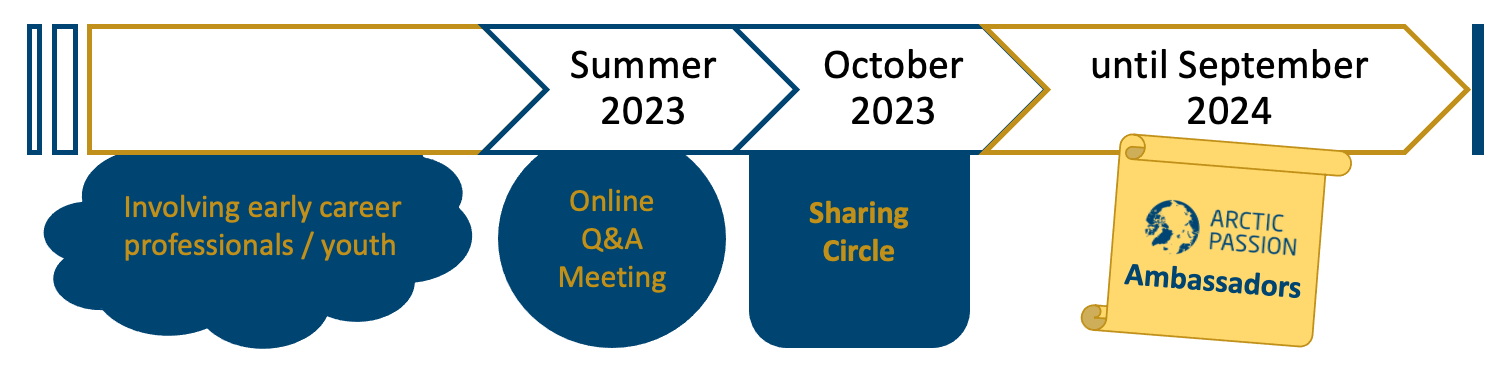
Why Northern Finland?
In the Arctic PASSION project we are honored to work with 6 Arctic communities. One of them is the Skolt Samí community in Sevettijärvi/Northern Finland. We are happy for this unique opportunity that we were able to stay with the Skolt Sámi community and together host the event there. This location on the home lands of this community allowed the participants to listen and to have meaningful conversations with members of the Arctic Indigenous community. Learning about Sámi livelihoods and culture enabled participants to understand conservation and restoration efforts of unique ecological habitats. The culturally important location introduced participants to different ecosystems and cultural heritage in an Arctic environment.
What does the program look like?
The program were filled with group discussions, presentations, outdoor activities and excursions. Presentations were given by community members, experts and participants. Participants gained a better understanding about Arctic life and about the intercultural and transdisciplinary complexity of the Arctic. The Sharing Circle enhanced the exchange of young people from Arctic and non-Arctic regions, promoting better collaboration with and among Arctic communities. The program contents were co-developed by the Sevettijärvi community, early career professionals, Arctic youth and Arctic PASSION partners like the Snowchange Cooperative. Participation in the Sharing Circle included one mandatory online event prior to the in-person meeting.
What is the ambassador project about?
After the Sharing Circle, participants have stayed connected with the Arctic PASSION project as Arctic PASSION Ambassadors for one year (until September 2024). They will share their newly gained knowledge and lessons learned with a wider audience of their choice through outreach products or projects. The project will be chosen and developed by each participant. Arctic PASSION Ambassadors act as multipliers and increase the reach of the Sharing Circle.
The ambassador projects can have a variety of formats, such as a blog, a presentation, activities with schools, engagements with other early career scientists. A similar ambassador project scheme was included in the MOSAiC School in 2019, see example projects here.
If you have any questions, please contact us via: This email address is being protected from spambots. You need JavaScript enabled to view it..
Organizers of the Sharing Circles are Lisa Grosfeld and Nadine Hillenbrand (Association of Polar Early Career Scientists, Alfred Wegener Institute) and Sarah Strand (Association of Polar Early Career Scientists, UiT The Arctic University of Norway).
This event has received funding from the Arctic PASSION project, which is funded by the European Union’s Horizon 2020 research and innovation programme under grant agreement No. 101003472, from the International Arctic Science Committee (IASC) and from the Norwegian Research Council.

0
Outreach Archive
0
Past Polar Weeks
© Ricardo Matias, Jukes Liu, Linde van Bets, Henrik Christiansen, Quentin Jossart (left to right)
Do you want to know some of the highlights that happened during our past APECS International Polar Weeks? Click on the blue boxes below for more information.
2
Polar Weeks 2020
© Ricardo Matias, Jukes Liu, Linde van Bets, Henrik Christiansen, Quentin Jossart (left to right)
Polar Week is a series of events happening globally, with the goal of promoting the science taking place in polar latitudes.
APECS hosted two International Polar Weeks in 2020:
- 15-21 March 2020
- 20-26 September 2020
You can find a summary of the Polar Week highlights of that year below:
1
Polar Weeks 2022
© Ricardo Matias, Jukes Liu, Linde van Bets, Henrik Christiansen, Quentin Jossart (left to right)
Polar Week is a series of events happening globally, with the goal of promoting the science taking place in polar latitudes.
APECS hosted one International Polar Week already and one will come in September 2022:
- 20-26 March 2022
- September 2022
You can find a summary of the Polar Week highlights of the Polar Week March below:
2
Polar Weeks 2021
© Ricardo Matias, Jukes Liu, Linde van Bets, Henrik Christiansen, Quentin Jossart (left to right)
Polar Week is a series of events happening globally, with the goal of promoting the science taking place in polar latitudes.
APECS hosted the International Polar Week in March 2021 and will host another one in September 2021:
- 14-20 March 2021
- 19-25 September 2021
You can find a summary of the Polar Week highlights of that year below:
2
Polar Weeks 2019
© Ricardo Matias, Jukes Liu, Linde van Bets, Henrik Christiansen, Quentin Jossart (left to right)
Polar Week is a series of events happening globally, with the goal of promoting the science taking place in polar latitudes.
APECS hosted two International Polar Weeks in 2019:
- 17-23 March 2019
- 23-29 September 2019
You can find a summary of the Polar Week highlights of that year below:
2
Polar Art Webinars 2019
For APECS International Polar Week September 2019, we organized two webinars on polar art and artists representations of the high latitudes on 25 September and on 27 September 2019.
2
Polar Weeks 2018
 Polar Week is a series of events happening globally, with the goal of promoting the science taking place in polar latitudes.
APECS hosted two International Polar Weeks in 2018:
- 19-25 March 2018
- 17-23 September 2018
You can find a summary of the Polar Week highlights of that year below:
2
Polar Weeks 2017
The Polar Week is a series of international events with the goal of promoting the science that takes place in polar latitudes, and educating the public about all things polar. For the Polar Week in March 2017 we were specifically highlighting humans and their activities and impacts on the poles. Did you know that there are people living in Antarctica year-round? Or that permafrost thaw is causing infrastructure damage and affecting communities worldwide? During the Polar Week in September 2017 our focus was on the polar world's effects on our longitudes.
APECS hosted two International Polar Weeks in 2017:
- 20-26 March 2017
- 18-24 September 2017
You can find a summary of the Polar Week highlights of 2017 below:
16
Polar Art
APECS invited members to participate in the Polar Week 2017 by sharing with us your experiences and your art. Here, we portray a series of artists that have worked in polar latitude and listen to them about their stories, sources of inspiration, and vision of the future.
6
Polar Science 101: Breaking Down Scientific Concepts For a General Audience
Understanding science is important for everyone, whether it is used for evidence-based decision-making, managing industrial companies, for employment, in voting as private citizens, or in making decisions about your home and family. Science communication is an important part of conducting research, especially in polar regions where access to in situ information is challenging for the public to obtain. The goal of this blog series was to breakdown some important topics in polar research so that a general audience can understand the key concepts.
There was one blog released each day during Polar Week with topics such as glaciers, sea ice, permafrost, paleo-climate, ice cores, and more! Changes happening in polar regions have global impacts, and everyone should be informed about the science happening there.
7
Polar Week Blog
For the Polar Week in September 2017 we specifically highlighted how we are living in a #PolarWorld, where issues happening in the poles affect everyone on the globe. To help promote #PolarWorld, and polar research in general, wel released a series of blog posts during Polar Week. We discussed some of the key issues happening in the poles that are affecting the globe, talking about international collaborations and conducting research internationally, and help raise awareness about some of the international activities APECS is a part of. Many thanks to the authors of the blogs for contributing to this series, including many APECS National Committees!
Topics
- September 18: Polar Issues are Global Issues
- September 19: Scientists All Over the World
- September 20: People of the Poles
- September 21: International Polar Policy
- September 22: Fun Friday - Research Stories
- September 23: How You Can Get Involved
- September 24: Polar Scientists of Tomorrow
2
Polar Weeks 2016
We celebrated on a global scale by focusing on the science being conducted in the Arctic and Antarctic. Inspired by the many great things that came out of the International Polar Year celebrations, we always hope that the bi-annual Polar Week celebration will link people in polar science and polar education. The polar regions of our planet contain some of the most diverse ecosystems in the world. These ecosystems support a rich array of life, both human and non-human, on both ends of the globe. Whether it's in the Arctic or Antarctic, scientists from all over the world are working together to increase our knowledge of the cryosphere and its inhabitants. It is for this spirit of international cooperation and the excitement of scientific discovery that the APECS proudly supports International Polar Week.
International Polar Week is an opportunity for APECS to promote polar science. APECS uses this opportunity to plan & develop polar science related activities alongside teachers, educators and those interested in polar education for the equinoxes of each year. The equinoxes in March and September are the only time when everywhere on earth the day length is 12 hours, a perfect opportunity to celebrate the poles on a global scale!
APECS organized two International Polar Weeks in 2016:
- 14-20 March 2016
- 19-26 September 2016
You can find a summary of the Polar Week highlights of that year below:
2
Polar Weeks 2015
APECS International Polar Weeks coincide with the equinox, the times a year when everyone on the planet gets 12 hours of sunlight. We want to celebrate on a global scale by focusing on the science being conducted in the Arctic and Antarctic. Inspired by the many great things that came out of the International Polar Year celebrations, we hope that the bi-annual Polar Week celebration links people in polar science and polar education. APECS uses this opportunity to plan & develop polar science related activities alongside teachers, educators and those interested in polar education.
APECS organized two International Polar Weeks in 2015:
- 21 - 29 March 2015
- 19 - 26 September 2015
You can find some of the Polar Week highlights from that year below:
1
Polar Weeks 2014
 APES International Polar Weeks coincide with the equinox, the times a year when everyone on the planet gets 12 hours of sunlight. We wanted to celebrate on a global scale by focusing on the science being conducted in the Arctic and Antarctic. Inspired by the many great things that came out of the International Polar Year celebrations, we hope that the bi-annual Polar Week celebration will link people in polar science and polar education.
APECS organized an International Polar Week in 2014:
- 20 - 28 September 2014
You can find a summary of the Polar Week highlights of that year below:
1
Polar Week 2013
APES International Polar Weeks coincide with the equinox, the times a year when everyone on the planet gets 12 hours of sunlight. We wanted to celebrate on a global scale by focusing on the science being conducted in the Arctic and Antarctic. Inspired by the many great things that came out of the International Polar Year celebrations, we hope that the bi-annual Polar Week celebration will link people in polar science and polar education.
APECS organized one International Polar Week in 2013:
- September 2013
You can find some of the Polar Week highlights from that year below:
1
Polar Weeks 2012
APES International Polar Weeks coincide with the equinox, the times a year when everyone on the planet gets 12 hours of sunlight. We wanted to celebrate on a global scale by focusing on the science being conducted in the Arctic and Antarctic. Inspired by the many great things that came out of the International Polar Year celebrations, we hope that the bi-annual Polar Week celebration will link people in polar science and polar education.
APECS organized two International Polar Weeks in 2012.
- 18 - 24 March 2012
- September 2012
You can find a summary of some of the activities that happened below:
0
Past Mountain Days
© Ricardo Matias, Jukes Liu, Linde van Bets, Henrik Christiansen, Quentin Jossart (left to right)
Do you want to know some of the highlights that happened during our past Mountain Days? Click on the blue boxes below for more information.
1
International Mountain Day 2020
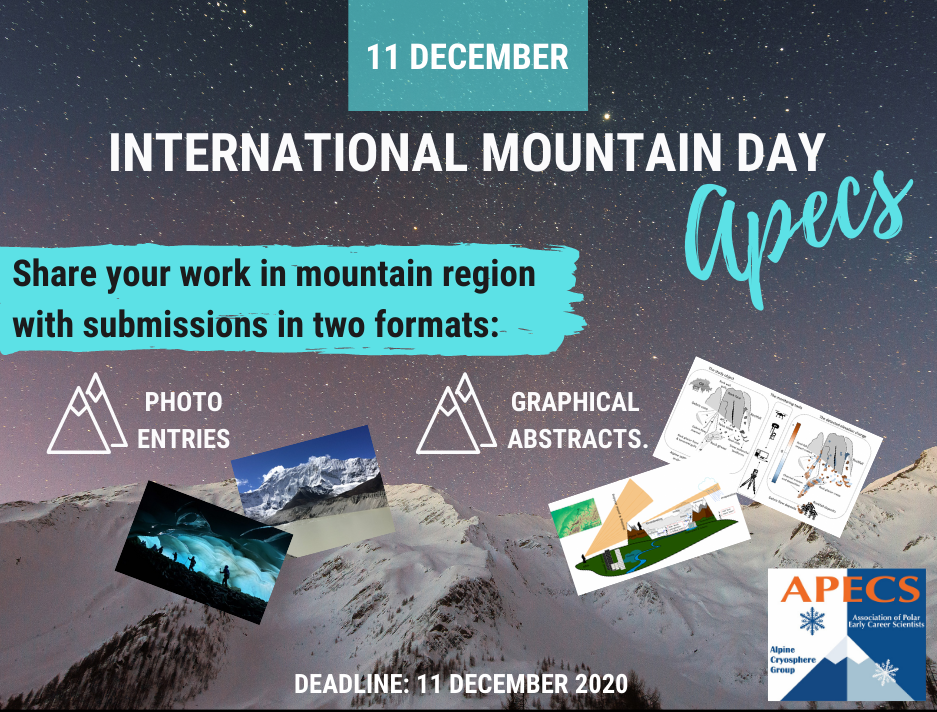 Mountains are incredible and unique landscapes that offer a wealth of natural and cultural resources on every continent. Mountain ranges have distinct climatic, ecological, and geological characteristics. They are a crucial component of the cryosphere and hydrosphere, providing water storage and distribution that extends to lower elevations. Mountains also occupy a central cultural and social role, with many cultures considering them as sacred places and sources of inspiration for histories and sagas. Alpine regions represent the opposition between refugee and hazard, solitude and danger, and environmental sensitivity and harsh conditions.
As part of the global activities for International Mountain Day on December 11th, we invited you to share your mountain experiences both artistically and scientifically through contributions in two formats: photo entries and graphical abstracts. All eligible submissions are displayed on the APECS website and social media.
Organized by the APECS Alpine Cryosphere Group.
© Greta Wells
0
Past Antarctica Days
© Ricardo Matias, Jukes Liu, Linde van Bets, Henrik Christiansen, Quentin Jossart (left to right)
Do you want to know some of the highlights that happened during our past Antarctica Days? Click on the blue boxes below for more information.
5
Antarctica Day 2020
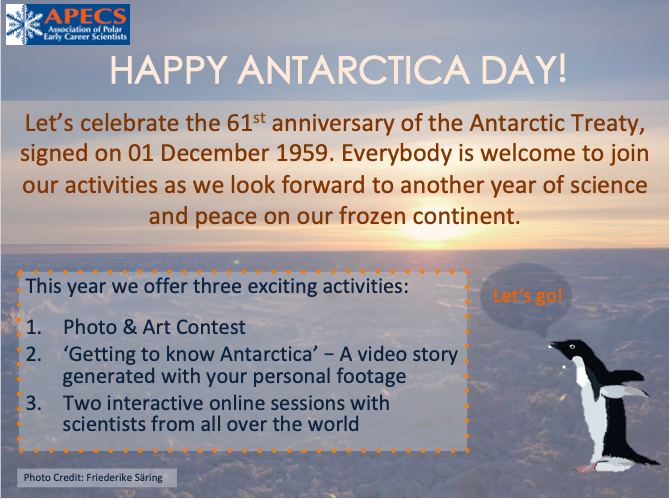
Celebrate Antarctica Day
with us!
1 December 2020
The international polar community celebrated Antarctica Day on the 1st of December to commemorate the 61st anniversary of the Antarctic Treaty. During this year, the APECS Antarctica Day Project Group (PG) planned a series of activities for all our members and national committees to raise awareness of the importance of Antarctica in a fast changing world.
We enthusiastically encouraged our early career researchers (ECR) to both join our activities and to communicate with us if you were planning something special to celebrate Antarctica with your community. Thanks to the wide collaborations between countries, we could expand and enrich our events and celebrated the spirit of international peace and scientific cooperation that signified the signing of the Antarctic Treaty in 1959.
On this occasion, the Antarctica Day PG organized the following activities for everyone to join:
© Friederike Säring
2
Antarctica Day 2019
Antarctica Day is celebrated internationally on 1 December, marking the day of the signing of the Antarctic Treaty in 1959.
60 years ago, Antarctica became a continent dedicated to peace and scientific international collaboration!
Like every year, APECS joins our partners Our Spaces - Foundation for the Good Governance of International Spaces, Polar Educators International (PEI), and others around the world to mark this important milestone with fun activities.
2
Antarctica Day 2018
APECS, Our Spaces - Foundation for the Good Governance of International Spaces, Polar Educators International (PEI), and other partners are celebrating Antarctica Day 2018 on December 1st, 2018.
2
Antarctica Day 2017
APECS, Our Spaces - Foundation for the Good Governance of International Spaces, the UK Polar Network, Polar Educators International (PEI), PolarTREC, the International Polar Foundation, the Scientific Committee on Antarctic Research (SCAR), Gateway Antarctica, the International Association of Antarctic Tour Operators (IAATO), the British Antarctic Survey and the Sultan Mizan Antarctic Research Foundation are celebrating Antarctica Day 2017 on December 1st, 2017.
2
Antarctica Day 2016
APECS, Our Spaces - Foundation for the Good Governance of International Spaces, the UK Polar Network, Polar Educators International (PEI), PolarTREC, the International Polar Foundation, the Scientific Committee on Antarctic Research (SCAR), Gateway Antarctica, the International Association of Antarctic Tour Operators (IAATO), the British Antarctic Survey and the Sultan Mizan Antarctic Research Foundation are celebrating Antarctica Day 2016 on December 1st, 2016.
4
Antarctica Day 2015
APECS, Our Spaces - Foundation for the Good Governance of International Spaces, the UK Polar Network, Polar Educators International (PEI), PolarTREC, the International Polar Foundation, the Scientific Committee on Antarctic Research (SCAR), Gateway Antarctica, the International Association of Antarctic Tour Operators (IAATO), the British Antarctic Survey and the Sultan Mizan Antarctic Research Foundation celebrated Antarctica Day 2015 on December 1st, 2015.
3
Antarctica Day 2014
APECS, Our Spaces - Foundation for the Good Governance of International Spaces, Polar Educators International (PEI), PolarTREC, the International Polar Foundation, Gateway Antarctica, the International Association of Antarctic Tour Operators (IAATO), eBIRD, the British Antarctic Survey and the Sultan Mizan Antarctic Research Foundation celebrated Antarctica Day 2014 on December 1st, 2014.
3
Antarctica Day 2013
APECS, Our Spaces - Foundation for the Good Governance of International Spaces, Polar Educators International (PEI), PolarTREC, the International Polar Foundation, Gateway Antarctica, the International Association of Antarctic Tour Operators (IAATO), eBIRD and the British Antarctic Survey celebrated Antarctica Day 2013 on December 1st, 2013!
6
Antarctica Day 2021
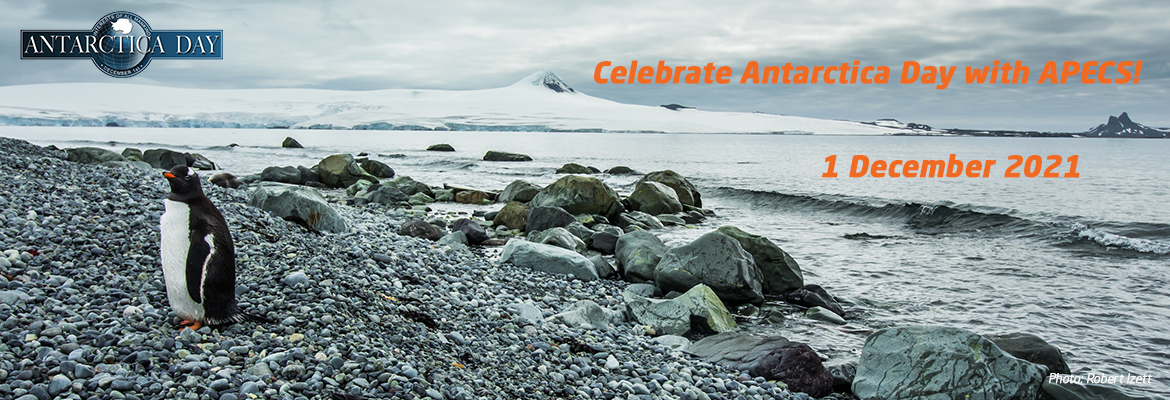
Antarctica Day is celebrated by the international polar community on 1st December 2021 to commemorate the signing of the Antarctic Treaty in 1959, which is considered to be one of the most successful achievements of the international community. The APECS Antarctica Day Project Group was excited to be part of these celebrations and was organising a series of activities to celebrate the day with all APECS members, APECS National Committees, as well as everyone who was interested in and passionate about Antarctica, with an overarching goal of raising awareness of the importance of Antarctica, especially in the light of a changing global climate.
We enthusiastically encouraged our early career researchers (ECR) to both join our activities and to communicate with us if you are planning something special to celebrate Antarctica Day with your community. We want to promote your activities, too! Thanks to the wide collaborations between countries, we could expand and enrich our events and celebrate the spirit of international peace and scientific cooperation that signified the signing of the Antarctic Treaty in 1959.
To reach our goal, we planned the activities described below to engage as many people as possible who want to share their exclusive Antarctic experiences and those who want to feed their curiosity about the continent of the extremes.
1
Research Archive
14
IPY EO Assessment 2010-2011
 The latest International Polar Year (2007-2009; IPY) was a huge success in many ways with education, outreach and communication (EOC) an important part of that success. After the close of IPY there were many lessons to learn from the numerous EOC efforts that took place around the globe. Recognizing IPY EOC as an important area that the world of science could learn from Jenny Baeseman (APECS) and Dave Carlson (UNAVCO, formerly IPY IPO) spearheaded an inventory and assessment of the IPY EOC activites conducted in 2010 and 2011.
In total over 550 projects were inventoried in over 70 countries. Activities, projects and programmes spanned the globe in more than 25 languages. The results of this study are the only known inventory and assessment of global IPY EOC activities to date. You can view the various project products below including a serachable database of all the activities (the Polar Outreach catalogue) and the formal ICSU report.
0
APECS Nordic Project 2013-2015
 APECS conducted the APECS Nordic “Bridging Early Career Researchers and Indigenous Peoples in Nordic Countries” project from 2013 - 2015. Funded through the Nordic Council of Ministers' Arctic Cooperation Programme, the project leveraged the research, education and outreach experience of the APECS network to identify ways to enhance engagement between Early Career Researchers and Indigenous peoples in Nordic regions.
This research initiative had been developed in response to some of the challenges in polar research. As stated during the Indigenous Peoples’ Global Summit on Climate Change in Anchorage (2009) “Indigenous Peoples have an important role to play in addressing climate change through their knowledge, experience and rights over land and development…however, this contribution has been largely ignored”. This is often a result of the communication gap between researchers and Indigenous peoples. Better incorporation of this knowledge into Arctic research as well as better communication between Northern residents and researchers is crucial. Thus, a demand for more training of Arctic researchers in how to approach Indigenous peoples, how to work with local experts and how to successfully and respectfully incorporate Traditional Knowledge in research projects is urgently needed.
Outcomes:
The final report of the project is available here.
A paper was published about the partial results of the survey conducted in the project:
- Sjöberg, Y, Gomach, S, Kwiatkowski E., and M. Mansoz (2019): Involvement of local Indigenous peoples in Arctic research — expectations, needs and challenges perceived by early career researchers. In: Arctic Science, 2019, 5(1): 27-53, https://doi.org/10.1139/as-2017-0045.
Activities:
The APECS Nordic Project was working towards enhancing engagement between Early Career Researchers and Indigenous peoples in several ways and you can read more about the various activities conducted here on this page.
APECS wants to thank:
... the APECS International Directorate sponsors - Research Council of Norway, UiT The Arctic University of Norway and the Norwegian Polar Institute - for their continued support through which projects like this are made possible. For the APECS Nordic Workshop, additional funding for travel support was provided by the US National Science Foundation, the International Arctic Science Committee and the Swedish Polar Research Secretariat.
APECS Nordic Project Team:
- Gerlis Fugmann (APECS / UiT The Arctic University of Norway, Norway) (Project Manager)
- Laura Fleming-Sharp (Arctic Studies Center at the National Museum of Natural History, United States) (Project Coordinator)
- Karolina Paquin (APECS / UiT The Arctic University of Norway, Norway) (Project Officer)
- Sandra Juutilainen (University of Oulu, Finland) (Workshop Organizing Team)
- Laura Lukes (North Carolina State University, United States) (Workshop Organizing Team)
- Julie Renee Bull (NunatuKavut Community Council / Toronto Aboriginal Support Services Council, Canada) (Workshop Organizing Team)
- Jocelyn Torma (University of Waterloo, Canada) (Webinar Team)
- Yulia Zaika (Khibiny educational and scientific base, Faculty of Geography M.V.Lomonosov Moscow State University, Russia) (Webinar Team)
- Ylva Sjöberg (Stockholm Universit, Sweden) (Survey Team)
- Mathilde Mansoz (France) (Survey Team)
- Sarah Nuernberger (University of Denver, United States) (Survey Team)
- Julia Skupchenko (Syktyvkar State University, Russia) (Database Coordinator)
2
APECS Nordic Resources
The APECS Nordic Project Team collected several resources during this project.
3
APECS Nordic Webinars
 The APECS Nordic Project “Bridging Early Career Researchers and Indigenous Peoples in Nordic Countries” featured a series of 6 webinars. The webinar series identified current research challenges from the perspective of ECRs and Indigenous peoples and aimed to define potential solutions to overcome these existing challenges to communication and other research issues. Webinars were held weekly in October & November 2013.
The webinar information and recordings are also available on in the APECS Webinar list on the APECS website.
6
APECS Nordic Workshop


 Culminating the APECS Nordic Project, “Bridging Early Career Researchers and Indigenous Peoples in Nordic Countries” was a 2-day in person workshop entitled “Connecting Early Career Researchers and Community Driven Research in the North” that was held at the Arctic Science Summit Week (ASSW) , and Arctic Observing Summit (AOS) in Helsinki, Finland, 7-8 April, 2014.
The APECS Nordic Workshop brought together approximately 60 key stakeholders including mentors and experts and Early Career Researchers and Indigenous peoples, youth and local expert representatives among indigenous peoples, senior scientists, key representatives of international organizations and other media. APECS worked closely with existing partners such as IASC, Arctic Council Indigenous Peoples’ Secretariat and the Swedish Polar Research Secretariat to identify and invite workshop participants and mentors. Travel funding to attend the Workshop was available through various sponsors.
The 2-day workshop included plenary sessions, breakout sessions, panel discussions, and group work. The goal of the workshop was to discuss and develop materials that educate and inform about the interactions between ECRs and Indigenous peoples in Nordic regions.
0
Research Discipline Pages - 2012-2014
0
Earth Sciences
Research in Earth Sciences focuses on the abiotic: how ice moves, where the mineral resources are, the rate of permafrost thaw...and many more topics.
At present we have information pages on:
Atmosphere and Climate
Contaminants in the Polar Regions
Glaciology
Ice-Ocean Interactions
Limnology
Permafrost
Sea ice
If you would like to update any of these pages or create your own, please contact This email address is being protected from spambots. You need JavaScript enabled to view it..
3
Atmosphere and Climate
 Polar atmospheric and climate sciences are hugely diverse, covering research topics as varied as air-snow interactions, tropospheric pollution, and stratospheric clouds! On this page we highlight the work APECS members are doing in these fields, introduce relevant mentors, and provide resources to help you better understand this complex and exciting research area.
This page was put together by Dr. Julia Schmale and Dr. Jenny Fischer. If you would like to add content, please contact This email address is being protected from spambots. You need JavaScript enabled to view it..
3
Contaminants in the Polar Regions
 The Arctic and Antarctic are “early warning messengers” for global processes, in particular for the environmental impact of current-use and emerging contaminants. Despite little to no industrial sources, the existence of persistent environmental contaminants in polar ecosystems has been known for a long time. However, we still know little about their sources, transport and health effects.
Research on these topics in Arctic and Antarctic organisms, along with spatial and temporal assessments, is very important for the industry, such as fisheries, environmental organisations, such as AMAP, EPA and the UNEP's Stockholm Convention, as well as for northern indigenous populations who subsist on traditional foods.
The Area of Research on “Contaminants in the Polar Regions” encompasses research on the sources, transport and fate of contaminants, their toxicity and health effects, bioaccumulation and biomagnification in polar species, exposure processes, as well as emerging topics such as the synergistic effects of contaminants and other stressors, such as climate change.
This page was put together by Emily Choy, Dr. Pedro Echeveste and Igor Eulaers. If you would like to add content, please email This email address is being protected from spambots. You need JavaScript enabled to view it..
5
Glaciology
 Glaciology is the study of glaciers, from small alpine valley glaciers with complex hydrology and influence over the local environment to large ice sheets with significant importance to global climate and sea-level. The majority of the world's glaciers are found in the polar regions and they have fundamental impacts on almost all areas of polar research. There are strong interdisciplinary links in particular with geology, hydrology, oceanography and atmospheric sciences.
This page was put together by Oliver Marsh. If you would like to add content, please contact This email address is being protected from spambots. You need JavaScript enabled to view it..
5
Ice-ocean interactions
 Within the past few decades, global climate change has lead to widespread changes in the mass and aerial extent of the Earth's glaciers, ice sheets, and sea ice as well as changes in the temperature and circulation of the oceans. This research feature focuses on the interactions between glaciers, ice sheets, sea ice and the oceans, the feedbacks inherent to the coupled systems, and the broader impacts of changes in ice-ocean interactions. The following two sections provide a brief overview of ice-ocean interactions at/near glacier margins and beneath sea ice.
Three webinars on ice-ocean interactions were held during February 2014 and recordings of the webinars can be found below. These webinars focused on the current understanding of ice-ocean interactions, the governing processes, and recent observations of rapid change, with a specific focus on the following three subject areas: sea ice in the Arctic, marine-terminating glaciers, and glacial fjords. Background information on glacier ice- and sea ice-ocean interactions can also be found in the overview sections included below. A more detailed understanding of ice-ocean interactions can be gained from the journal articles listed beneath the overviews. The abstracts and full citation information can be used to easily locate the full-length articles using either the journal links provided near the bottom of the page or electronic library resources.
If you have any questions regarding the content of this research feature or you would like to recommend another article for the list below, please contact This email address is being protected from spambots. You need JavaScript enabled to view it..
This page was put together by Dr. Ellyn M. Enderlin and Dr. Alexey Pavlov.
2
Limnology
 Limnology is the study of inland waters ranging in size from large lakes down to puddles, as well as wetlands and running-water systems such as streams, rivers and estuaries. Inland waters range from very fresh glacier- or groundwater-fed systems, to brackish saline waters in isolated or ocean-influenced basins. Inland water bodies can be permanent features of the landscape, or may be ephemeral features that are only present seasonally. The wide variation in possible sizes, physicochemical characteristics and permanence of inland waters makes limnology a very diverse field of study!
Studying limnology in polar regions adds even more complexity – there are extreme variations in light, nutrient availability and temperature amongst seasons. The presence of a seasonal ice cover, near-desert conditions in surrounding tundra landscape, and very low temperatures all exert strong influences on polar inland waters.
Limnology is an important field of study in the polar regions because lakes and rivers are abundant in the arctic, and in some parts of Antarctica as well. Understanding the processes that occur within a catchment gives a better perspective on interactions within the landscape. For instance, biogeochemical processes generally occur more rapidly in water than they do in polar soils or terrestrial vegetation, making aquatic habitats hot spots for biodiversity and productive aquatic food webs. In the arctic, processes occurring in inland waters also have important impacts on the world’s oceans, because riverine outflow to the Arctic Ocean influences the global thermohaline circulation.
This page was put together by Jolie Gareis, Dr. Heather Mariash and Dr. Nikolaus Gantner. If you would like to add content, please contact This email address is being protected from spambots. You need JavaScript enabled to view it..
3
Permafrost
 Permafrost is recognized by the World Climate Research Programme (WCRP/WMO) and Climate and Cryosphere (CliC) as a key element of the Earth System. Permafrost is present in ca. 25% of the Northern Hemisphere continental area and on all the ice-free areas of the Antarctic continent, including wide areas under the ice-sheet. Permafrost is central to the carbon cycle and hence to the climate system, especially due to methane and carbon dioxide release following permafrost degradation. This issue is especially sensitive in the Arctic, but detailed studies are lacking in the Antarctic. Therefore, especially in the ice-free areas, the warming of permafrost (climatic and human-induced) can generate problems to existing or planned research facilities, which can be potentially subject to risk. Permafrost monitoring is therefore also an important issue relating to environmental impact assessment and mitigation in ice-free terrain Antarctic facilities.
1
Sea Ice
 Sea ice is defined as ice that grows in the ocean. It is an integral component in an intricate ecosystem that provides stability and nourishment in the food web in the Arctic and Antarctic regions. Though this is a significant component in ecological, biogeochemical, and geophysical systems at the poles, it also influences oceanic and atmosphere interaction on a global level. The physical structure of sea ice provides a significant contribution to Earth's ability to reflect and absorb incoming solar radiation. The reflectivity studied is known as albedo, which is the ratio of outgoing reflected radiation from the surface to incoming radiation. Optical properties in the different sea ice types, such as brine inclusions, air, and solid salts, govern the portion of incoming radiation that is reflected,absorbed, and scattered. Another important aspect of sea ice thickness pertains to the sea ice brine flux and its effect on thermohaline circulation (THC) affecting deepwater formation and upper ocean stability through saltwater and freshwater fluxes.
0
Life Sciences
Research in Life Sciences focuses on the biotic: which species live where, what are the trophic interactions, are populations sustainable...and many more topics.
At present we have information pages on:
Marine Biology
Microbial Ecology
Terrestrial Ecology
If you would like to update any of these pages or create your own, please contact This email address is being protected from spambots. You need JavaScript enabled to view it..
2
Microbial ecology
 Microbial ecology is the study of interrelationships between microorganisms and the living and non-living aspects of the environments that they inhabit. Microorganisms are important players in Polar habitats, where they are major drivers of biogeochemical cycles in aquatic and terrestrial ecosystems. In the Arctic, for example, the thawing of permafrost could lead to increases in microbial activities and carbon decomposition, resulting in accelerated release of greenhouse gases. In the Antarctic, microorganisms are important in mediating nutrient cycling in surface lakes and subglacial environments, which are thought to carry important nutrients to the surrounding Southern Ocean. Additionally, studies focusing on the survival mechanisms of microbes exposed to sub-zero conditions or freeze-thaw cycles contribute to our understanding of the resilience of life and to advances in the fields of biotechnology and astrobiology. Answering basic questions about microbial ecosystems can be difficult, as the systems cannot be observed directly, but recent technological advances allow the construction of molecular “blueprints”, which are keys to describing and understanding microbial ecosystems. Large quantities of these molecular data help inform our understanding of microbial population structures and metabolic activities, as well as how these elements interact with the environment as a whole. Combining current molecular approaches with field-based measurement and laboratory-based culture studies allows today’s microbial ecologists to examine important issues ranging from the impact of changing climate on nutrient cycling to life’s ability to survive in extreme environments.
This page was put together by Eric Collins, Tristy Vick-Majors and Dr. Punyasloke Bhadury
3
Terrestrial ecology
 Ecological research in polar regions explores interactions between various groups of organisms, as well as relations that they have with respect to their environment. Despite the apparent harshness of the Arctic and Antarctic, many creatures are well adapted to living "at the edge". Ecosystems of the tundra biom are not as simple and primitive as it may seem!
Polar organisms are now facing a threat much more difficult to cope with than extreme cold, drought and darkness - a rapidly changing climate. Increasing air temperature causes melting of glaciers and permafrost, changes in water relation and growing season. These changes affect all ecosystem components. New ecosystems are forming in areas uncovered from under the ice, whereas at the southern borders of the Arctic shrub and tree expansion is underway, reducing the extent of the tundra. Great research effort is put to monitor the speed and direction of these changes, to provide effective conservation of the fragile tundra ecosystems.
This page was put together by Maja Lisowska.
2
Marine biology
 While polar terrestrial ecosystems appear to be snow and ice deserts most of the time, their marine counterparts bustle with life throughout the year. Vast amounts of plankton and ice-associated organisms sustain the marine, but also major parts of the terrestrial food web, all the way up to the highest predators, including penguins, seals and polar bears. Their annual cycles are extremely seasonal, but the strong plankton blooms in the spring set off a feeding extravaganza that does not only sustain the local fish, bird and sea mammal life, but even causes huge whales to travel to the polar regions over thousands of miles to feast there. Although the planktonic community is generally not very species-rich, its high abundance provides food input for an astonishing diverse and colourful benthic fauna as well. However, systems with low numbers of species are at the same time more vulnerable for impacts of global changes. International and interdisciplinary research efforts attempt to understand the biological responses to warming, sea ice retreat, freshwater input and other anthropogenic impacts such as ocean acidification and pollutants. Various types of models are developed to predict changes in the marine community structure that will impact greatly on these ecosystems and may have major repercussions on a global scale. These predictions can only be made in close collaboration with other disciplines such as physical oceanography and atmospheric sciences.
The ocean does not only cover two thirds of the Earth’s surface thereby linking polar regions and the tropics but it is also home to a multitude of microbial species, fish and mammals, it provides food for many people, and it buffers climate change.
Already now scientists observe rapid sea ice decrease and sea level rise endangering rare species like the polar bear but also entire human settlements in shallow coastal regions. What will happen to the CO2 storage capacity of the ocean with increasing water temperatures? And how will fish, penguins, albatross and seals survive if humans keep harvesting krill? All these questions, concerns, and much more is addressed in the various fields of research related to polar marine science.
This page was put together by Claudia Maturana Bobadilla Chile and Tosca Ballerini.
0
Social & Human
Research in Social & Human focuses on people, the people living in the polar regions either permanently or visitors who visit these regions for research or tourism.
At present we have information pages on:
Antarctic Social Sciences
Anthropology
Field Safety
International Polar Year
Russian Arctic
Traditional Knowledge
If you would like to update any of these pages or create your own, please contact This email address is being protected from spambots. You need JavaScript enabled to view it..
4
Antarctic Social Sciences

Antarctica encompasses a rich range of human interactions that is increasingly becoming inseparable from its natural environment. Although no indigenous populations live on Antarctica, the continent is home to scientific research stations from 30 different countries and is the destination of choice for an increasing number of tourists. Understanding the history of human presence, its social and anthropological dynamics, its politics and its shared cultural constructions are important themes in Antarctica Social Science research and management. The Antarctic Treaty was ratified in 1961 to ensure “in the interests of all humankind that Antarctica shall continue forever to be used exclusively for peaceful purposes and shall not become the scene or object of international discord”. However, as several countries have overlapping territorial claims, future geopolitical tensions could jeopardize the treaty. Millions of people have been exposed to Antarctica through its popularization in the media (books, film, TV, art) and this has prompted curiosity and questions of value. The costs of human presence in Antarctic are remarkable from economical, environmental and cultural points of view. Therefore, Antarctica has become the object of innumerable debates and balancing these different viewpoints could have global implications particularly when they affect climate and international policy. Thus, Antarctic Social Science provides a vital contribution to the region's future.
If you are interested in helping out or adding content then please email This email address is being protected from spambots. You need JavaScript enabled to view it.
The content of this page and the webinars were put together by the Antarctic Social Sciences Working Group: Hanne Nielsen, Daniela Sampaio, Daniela Liggett, Sira Engelbertz, Nelson Soto Santibanez, Hugo Romero, Dora Barbalho, Alex Calvo, Heloisa Lemmertz and Ruth Hindshaw
4
Anthropology
 Anthropology is the scientific study of the origin and behavior of man, including the development of societies and cultures. Traditionally anthropology is divided into two fields, biological anthropology and cultural anthropology, both of which have their own sub-branches.
Biological anthropology focuses on the study of human populations using an evolutionary framework. Biological anthropologists have theorized about how the globe has become populated with humans, as well as tried to explain geographical human variation.
Cultural anthropology is the study of culture based on methodology that heavily relies on participant-observation. Cultural anthropologists use ethnographic examples to defend their theories. Ethnography is the product of research, a monograph or book describing in detail a specific culture. Indeed, the process of participant-observation can be especially helpful to understanding a culture from an emic point of view; which would otherwise be unattainable by simply reading from a book. The study of kinship and social organization is a central focus of cultural anthropology, as kinship is a human universal. Cultural anthropology also covers economic and political organization, law and conflict resolution, patterns of consumption and exchange, material culture, technology, infrastructure, gender relations, ethnicity, childrearing and socialization, religion, myth, symbols, values, etiquette, worldview, sports, music, art, nutrition, recreation, games, food, festivals, and language.
Because of the holistic nature of anthropological research, all branches of anthropology have widespread practical application in diverse fields. This is known as applied anthropology. Thus military expeditions employ anthropologists to discern strategic cultural footholds; marketing professionals employ anthropology to determine propitious placement of advertising; and humanitarian agencies depend on anthropological insights as means to fight poverty. Examples of applied anthropology are ubiquitous.
This page was put together by Nelson Soto Santibanez, Rosa Rut Thorisdottir and Luis Guilherme de Assis. If you would like to add content, please contact This email address is being protected from spambots. You need JavaScript enabled to view it..
3
Field Safety
Are you concerned with field safety while conducting work in the polar regions? Whether you've organized field-work for years or you're participating in your first field campaign, knowledge of basic field safety skills is of the utmost importance. In order to increase field safety awareness, APECS is hosting a series of webinars on field safety throughout the 2015 Arctic summer field season.
3
International Polar Year
 The 2007-2008 International Polar Year (IPY) was an interdisciplinary, worldwide scientific program focused on the Arctic and Antarctic. The IPY was the fourth in a series that began in the late nineteenth century, with three previous manifestations in 1882-83, 1932-33, and 1957-58. The IPY involved over 200 projects from over 60 nations, which focused on all areas of physical, biological, and social sciences. The IPY also provided an unprecedented opportunity to translate scientific knowledge into information relevant to policy. The success of the IPY was showcased at the IPY: From Knowledge to Action conference in April of 2012 in Montréal.
This page was put together by Tristy Vick-Majors. If you would like to add content, please contact This email address is being protected from spambots. You need JavaScript enabled to view it..
2
Russian Arctic
 Russian Arctic area stretches over 9 time zones and nearly halfway around the world, shares borders with Norway and Finland in the West, and extends East through Siberia to the Bering Sea. The Chukotka Peninsula almost touches Alaska.
Russian Arctic is the territory of vast expanses of tundra and forest-tundra, islands featuring polar deserts and semi-desert terrain, mountains, lakes, streams and surrounding shelf seas. It’s the area of an abundance of wildlife with nearly every species of Arctic mammal, including Polar bears, Artic foxes, Greenland whales, Narwhals, Beluga whales, Atlantic walruses, Ringed seals, thousands of wild reindeers and about 1000 varieties of plants.Historical artifacts and monuments, the highest ethnic diversity are integral components of Russian Arctic.
Arctic plays a key role in the Russian economy. It is particularly noted for its mineral wealth but also plays a key role in shipping and transportation. The major and biggest northern routes lie in this part of Arctic - the Trans-Siberian Railway and the “Northern Sea Route”.
From a scientific perspective, Russian Arctic is one of the least studied regions in the North. Recent changes in sea ice cover, ecosystems, state of the permafrost and atmospheric conditions urge scientific community to make coordinated interdisciplinary and international efforts to understand a current state and to predict a future of the Russian Arctic.
This page was put together by Yulia Zaika and Alexey Pavlov
2
Traditional knowledge
 Polar research involves knowledge gathering and information integration from many sources. In the Polar Regions, Traditional Knowledge (TK) plays a central and important role. The notion and definition of traditional knowledge varies across geography, disciplines, and peoples, however, is becoming increasingly recognized as valuable information and knowledge in the area of polar science in particular. Discussions pertaining to traditional knowledge also relate to local knowledge, indigenous knowledge or traditional ecological knowledge.
Traditional Knowledge has many definitions, however the core definition is well described by an elder fromjpg Tuktoyaktuk in the Inuvialuit Settlement Region: Traditional Knowledge is the pride in knowing your culture and knowing how to survive in your surroundings. Traditional Knowledge is a rich knowledge base, it is knowledge gained from the experience of living on the land and knowledge passed down by ancestors, and it takes a holistic approach to understanding the environment. As science often takes a reductionist approach to understanding the environment, using Traditional Knowledge and scientific knowledge together creates a more in-depth understanding of ecosystems or species of study.
These pages summarize the different areas of Traditional Knowledge and provide the reader with various resources and opportunities to learn about the important discussions amongst traditional knowledge holders and experts in this area. Map Source: Arctic Council.
This page was put together by Jennie Knopp, Yulia Zaika and Laura Fleming-Sharp.
1
Traditional Knowledge in your research
Below we have provided a list of materials that will give you ideas, methods and things to consider when incorporating Traditional Knowledge in your research.
1
APPLICATE

 APPLICATE - Advanced Prediction in Polar regions and beyond: modelling, observing system design and LInkages associated with a Changing Arctic climaTE
Project Duration: 2016 - 2020
Massive changes are occurring in the Arctic – retreating sea-ice, warming oceans, and a warming atmosphere – which have the potential to influence weather and climate well beyond the region itself. These profound transformations are projected to continue well into the future, opening up new opportunities, such as shorter shipping routes, but also exposing major risks, such as environmental hazards associated with increased activity in the Arctic. The growing interest and infrastructure in the Arctic means there is a strong need for improved weather and climate predictions on a wide range of temporal and spatial scales.
The APPLICATE project aimed to address these needs by bringing together a multinational and multidisciplinary consortium to advance our capability to predict weather and climate in the Arctic and beyond. APPLICATE brought together experts from both the weather and climate communities across universities, research institutes, and operational prediction centres; a composition ensuring effective knowledge transfer from science directly to operations.
Find out more about APPLICATE on the project website: https://applicate.eu/
APPLICATE has received funding from the European Union’s Horizon 2020 research and innovation programme under grant agreement No 727862.

1
APPLICATE FrostBytes
A collection of FrostBytes were developed as part of the science communication sessions of the Polar Prediction School held in Abisko, Sweden, from 17-27 April 2018. Find out what each of the students is researching:
3
APPLICATE webinar series
As part of APPLICATE, APECS organised a series of webinars focused on topics related to APPLICATE. These webinars can be found below or in our webinar archive, while more information about APECS' contribution to APPLICATE can be found on the project page.